

The Benefits of Lionberry
Elderberry Phytochemicals Work in Our Bodies
- Cancer Health: Elderberries contain anthocyanins that may reduce the risk of cancer and stop colon cancer cells from growing by up to 60%.
- Blood Sugar Health: Elderberry may help prevent diabetes by fighting insulin resistance, lowering blood glucose levels, and reducing inflammation.
- Gut Health: Elderberries are high in fiber, which may help promote gut health.
- Skin Health: Elderberries contain antioxidants that may help protect skin from pollution, smoke, and UV radiation.
Elderberry Plant Benefits Protect Us From The Crowd
- Immune Health: Elderberry contains anthocyanins, which can attach to viral glycoproteins and prevent viruses from entering host cells. Elderberry extracts have shown inhibitory effects on Influenza A, B, and H1N1 viruses.
- Suppress Viruses: Elderberry contains high amounts of polyphenolic compounds, such as flavanols, phenolic acids, and anthocyanins. These polyphenols can suppress the activity of viruses and bacteria.
- Immune Boosting: Elderberry contains acid polysaccharides, such as pectins, which may boost immune function by stimulating macrophages.
The below information is cited from Specialty crop science. (Jenny Blair)
Brain science
Elderberry Juice Might Speed Up Thinking in Elderly People With Early Dementia (Musich et al., 2025; RL 7)
What people eat can affect their brain health. Scientists know that eating plants with certain natural chemicals can help with memory. In this study, they wanted to see if these chemicals can help older people with early dementia. They compared juice from American elderberry and a flavor drink that tasted the same.
Twenty-four elderly people with very mild dementia took part in the study. They took tests, such as word puzzles, to measure how mentally sharp they were. Then, three times a day for 6 months, they took a teaspoon of juice. Some people took elderberry juice the whole time. Others took the flavor drink. Which juice each person took was kept secret until the end of the study. At 3 months and again at 6 months, the elderly people took the thinking tests again. Between the beginning and end of the study, scientists compared test results.
Thinking seemed to speed up slightly in the group of people who took the elderberry juice. It did not speed up in the group who took the flavor drink.
The study was small and scientists are still not certain that the juice helped. But the results were promising. Bigger studies should help us understand how American elderberry juice might affect brain health.
Natural Substances in American Elderberries Protected Mice From Stroke Injury (Banji et al., 2022; RL 9)
Scientists are studying the brain health benefits of natural chemicals called anthocyanins. Anthocyanins occur in some plant foods, including colorful berries like elderberries. They fight inflammation in the body. Inflammation is a complex immune response meant to protect the body, but it can also harm the body. Some brain disorders occur with inflammation, such as Alzheimer’s. Inflammation can also play a role in depression, anxiety, and bipolar disorder.
After mice eat anthocyanins, they show up in the bloodstream within 20 minutes. Likely a similar thing happens in humans. Some also travel down the gut, where they may nourish the good bacteria living there. Anthocyanins also wind up in the liver, heart, kidney, and brain. Their ability to cross from the blood into the brain surprised some scientists. The brain has a protective barrier to keep out many chemicals. In the brain, anthocyanins interfere with inflammation in a number of ways.
In one study, scientists added inflammatory chemicals to mouse brain immune cells. As expected, the cells erupted with an inflammatory response. Then they tried again after first adding American elderberry extract. This time, the cells’ inflammatory response was mostly blocked. The scientists believe this was due to anthocyanins in the elderberry.
Other experiments have found possible protective effects of anthocyanins. These experiments looked at anthocyanins in other plants. Benefits occurred in animal studies of alcohol, high-fat diets, and Huntington’s disease. In humans, benefits have been seen in studies of early dementia.
Much science remains to be done on anthocyanins. We do not know enough about the right dose for human beings, nor how much might be too much. Anthocyanins might interact with medications in ways we don’t yet understand. And they might affect different people differently.
American Elderberry May Protect Brain from Stroke Damage (Banji et al., 2022; RL 8)
Scientists tested whether two plant extracts could protect against brain damage from stroke. They tested elderberry and an African plant called Sutherlandia. Groups of mice eating normal diets were compared for two months. Some had dried Sutherlandia powder added to their food. Others had dried American elderberry powder added to their food. Still others ate a normal diet with no supplements.
Under anesthesia, all the mice had surgery. In most of the groups, scientists interrupted, then restored blood flow to the brain, like a stroke. For comparison, some mice had surgery without the stroke.
When the mice woke up, scientists tested their coordination. They also examined the mice’s brains. Among mice that had strokes, those that had eaten the plant powders were more coordinated. Their brains also showed less damage. Mice that had not eaten the powders were less coordinated and had more damage.
Scientists know oxidation and inflammation can hurt the brain after stroke. In mice, eating these plants before stroke seemed to cut down on this type of brain damage. American elderberry can reduce brain damage from stroke in mice. It’s worth exploring whether the plant could help humans in this way too.
Cancer
American Elderberry Extracts Inhibit Brain Tumor Cells In Lab (Lamy et al., 2018; RL 8)
Glial cells protect and nourish nerve cells. Glioma is a type of brain cancer that happens when glial cells divide, get out of control, and form a mass (a tumor).
Like healthy parts of the body, a tumor needs a blood supply, because blood delivers oxygen. These tumors direct the body to create new blood vessels. As gliomas grow, their new blood vessels do a spotty job delivering oxygen. This lack of oxygen turns on genes, or instructions inside the cells, that make the glioma harder to treat.
American elderberry contains natural health-giving chemicals. In this study, researchers wanted to build on a 2006 study that found elderberry may fight cancer. They used extracts from elderberry and elderflower. They also lined up individual chemicals derived from elderberry, plus a chemical mix. They wanted to see how each of these affected glioma cells and blood vessel cells.
In containers, they bathed glioma cells in extracts, individual chemicals, or the mix. To simulate what happens in real tumors, they reduced oxygen supply to some cells.
The extracts, especially the berry ones, reduced some glioma cells’ tendency to divide. This was true both when normal and low amounts of oxygen were present. Individual chemicals also did this. They worked better as a mix than on their own. Berry extracts revved up self-destruction in blood vessel cells and some glioma cells.
These results add to evidence that elderberry might inhibit cancers.
A government ministry and a university in Quebec, Canada funded the study. The researchers declared they had no financial conflicts of interest.
American Elderberries Have Anti-Cancer Properties (Thole et al., 2006; RL 9)
Elderberries contain natural health-giving chemicals. These chemicals can fight cancer, boost the immune system, and weaken flu virus. European elderberry has been bred for many years as a medicinal plant. It is used in some popular drugstore medicines. American elderberry is more wild, but it too has been traditionally used for medicine. In this study, scientists compared both kinds of elderberry for their cancer-fighting powers. They used chemistry to isolate natural chemicals from each type of berry. Then they ran tests on the chemicals. Both elderberry types proved able to combat cancer processes in these lab tests.
Metabolism
Elderberry Might Help With Blood Sugar and Fat Burning (Teets et al., 2024; RL 8)
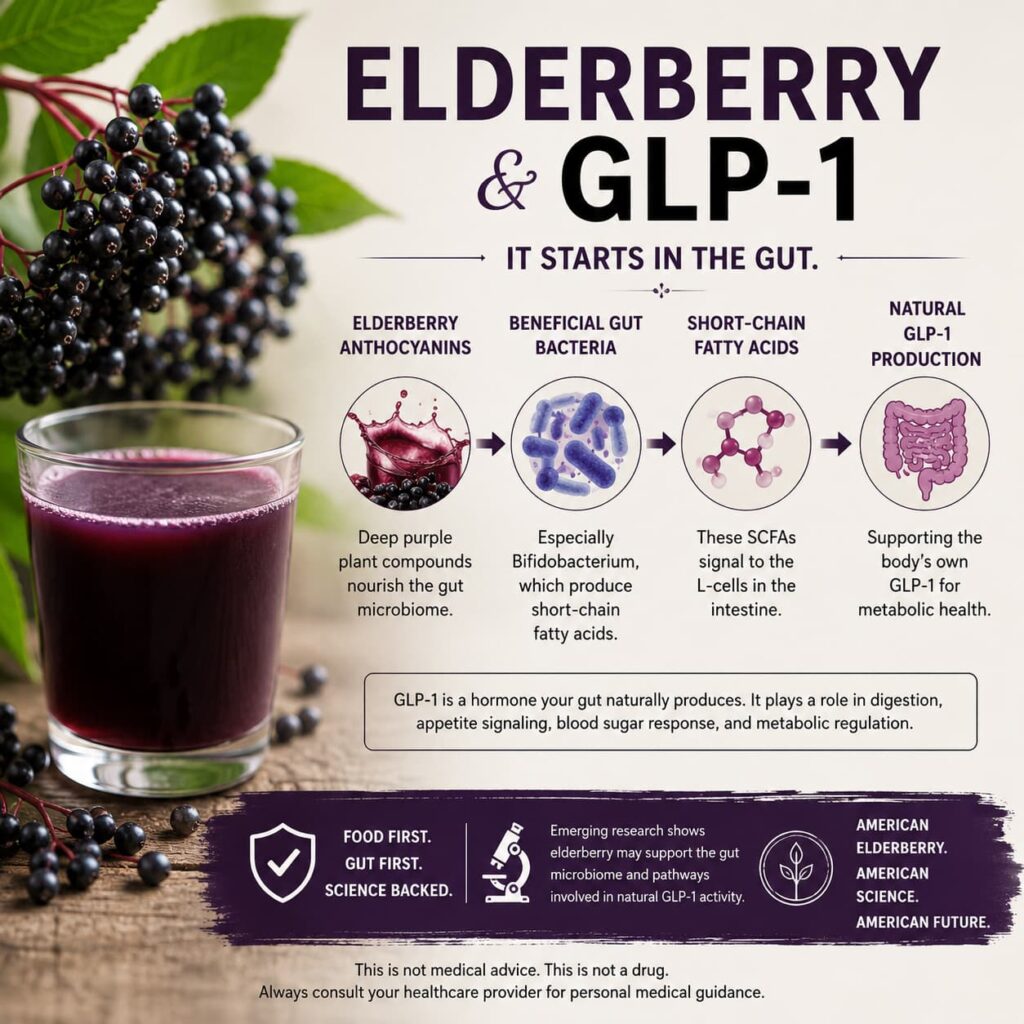
Some scientists suspect healthful chemicals in berries may help people control their weight. The chemicals might help by nourishing the beneficial bacteria living in our intestines.
Scientists asked overweight people to participate in a study using American elderberry juice. In this study, 18 people spent one week drinking either elderberry juice or an imitation. Then each person switched over to the other drink for one week. During the study, the participants ate a controlled diet and gave samples of blood and poop. Scientists checked blood sugar and studied bacteria in the poop.
After the period of drinking elderberry juice, people’s bodies changed. They had slightly more healthful bacteria in their poop. Their blood sugar was better. And fat burning increased. These changes did not occur after the imitation drink. This study suggests American elderberry might help with gut health and weight management. Still, this was a small, brief study, so the results aren’t definitive. Longer studies with more people will help give a clearer picture.
Processing and storage
Unlike European Elderberries, American Elderberries Lack Certain Toxic Chemicals (Appenteng et al., 2021; RL 9)
Some plants naturally contain small amounts of chemicals that can turn into poison. These chemicals help protect the plants from disease and from being eaten. Elderberries in Europe have some of these chemicals, which can turn into cyanide in the body. So these chemicals have to be destroyed to make healthy drinks, foods, or supplements. This may be done by heating, which could destroy healthful chemicals in elderberries.
Scientists checked to see if American elderberries also contain these chemicals. They tested store-bought American elderberry juice. They also tested seeds, skin, pulp, stems, juice, and berries from the American plant.
Store-bought juice had none of the chemicals. Small amounts were in the fresh plant parts, especially in stems and unripe berries. But levels were too low to be harmful, and they were much lower than even the harmless levels in fresh apple juice.
Products made from American elderberry may not need as much processing.
References to heat & processing based on interviews.
Does Freezing Affect Elderberry Anthocyanin Levels? (Johnson et al., 2016; RL 9)
American elderberries have beneficial chemicals called anthocyanins and polyphenols. Freezing is a useful way to preserve fresh elderberries. But it hasn’t been clear how freezing affects the anthocyanins and polyphenols.
The scientists planted three different types of American elderberry. They harvested ripe berries, deep-froze them for one week, thawed them, and made juice. They measured levels of the two chemical types in the juice. Then the scientists froze juice samples. They thawed and tested the juices again after 3 months, 6 months, and 9 months in the freezer.
They found that anthocyanin and polyphenol levels differed among the cultivars’ fresh juice. Bob Gordon had the highest levels of both.
For polyphenols, all three lost some in the first three months of storage, then losses leveled off. At the 9-month mark, all three had at least 72% of their original amounts of polyphenol.
As for anthocyanins, the scientists checked two types: monomeric and individual anthocyanins.
For monomeric anthocyanins, all three cultivars lost large amounts during frozen storage. Bob Gordon had the highest levels by far after 9 months—about 58% of what it started with. Wyldewood had 28% and Adams II had 18% of their initial anthocyanins after 9 months.
Individual anthocyanins were less stable than monomeric during frozen storage. For all three cultivars, individual anthocyanins were almost gone by 9 months.
United States government agencies funded this study.
Viruses & immunity
European Elderberry Killed Flu But Not Covid Virus In A Lab (Eggers M. et al., 2022; RL 7)
Viruses that infect the lungs often spread down from the nose, mouth, and throat. Gargling with rinses or with certain natural products may cut down on virus spread. That could reduce sickness and the spread of sickness.
In this study, researchers tested several plant-based liquids in a lab. They wanted to see how well these liquids do at killing viruses. In other words, they studied the liquids’ ability to be virucidal. They tested green tea, chokecherry juice, elderberry juice, and pomegranate juice. They tested flu virus and SARS-CoV-2, plus a tough virus called MVA.
Each juice or tea was mixed in a container with virus. Then the scientists checked to see how much virus had died off.
Of all the liquids, chokeberry juice was the strongest virucide. It reduced flu virus and SARS-CoV-2 by over 99% in 5 minutes. Chokeberry also knocked back MVA by 96% in 1 minute.
All four liquids reduced influenza virus by over 99% in 5 minutes. Pomegranate juice and green tea cut SARS-CoV-2 by about 80% in 1 minute. But elderberry juice did not significantly kill SARS-CoV-2 in this study.
All scientific studies have limitations. In this study, humans didn’t gargle with the liquids. That’s important because how a substance interacts with viruses in a dish or test tube may differ in people. The scientists added vitamin C to the green tea, though that is not how people usually make it. All the juices were prepared with heating (pasteurization). Heating juice, while it kills harmful germs in the juice, might also change its properties. The elderberry juice in this study came from a German supplier. American elderberries might work differently.
A nonprofit called German Cancer Aid paid for the study. Two of the researchers are partners in a company that makes dietary supplements.
Elderberry Shifted the Immune System’s Response to Viruses (Schön et al., 2021; RL 8)
Scientists studied natural plant chemicals in a commercial elderberry product called Eldosamb. This powdered extract contains health-giving chemicals called anthocyanins. The scientists wanted to learn how the extract interacts with the immune system.
In one part of the experiment, the scientists studied if elderberry could kill a virus called MVA. (The MVA virus has some similarities to coronavirus and flu virus but it is safer to study.) First the scientists infected cow cells with the virus. Then they mixed elderberry in with some containers of cells and not others. Finally they measured virus amounts in the two types of containers and compared. The elderberry strongly reduced virus amounts. It also reduced the virus’s power to infect new cells.
For the other part of the experiment, ten volunteers donated blood. In test tubes, the scientists mixed elderberry powder into the blood. They measured which immune chemicals the blood cells released in response to elderberry. These immune chemicals determine which path the body takes to fight off infection.
They found that elderberry steers immune cells down a path called the TH2 response. In the TH2 path, the body makes antibodies to fight viruses. The TH2 path also hits the brakes on inflammation. (The other path, the TH1 immune response, revs up inflammation. Inflammation can fight cancer cells and some types of germs. But it can be harmful if it goes haywire or lasts too long.) Elderberry can shift the immune response in a way that could be beneficial.
Elderberry Protected Laboratory Cells from Influenza (Roschek et al., 2009; RL 8)
Every plant, including elderberry, contains a mix of natural plant chemicals or compounds. In a dish, scientists mixed an elderberry extract with a strain of flu called H1N1. They found that, in high doses, the extract kept the flu from infecting dog cells in the dish. Normally these cells are sensitive to flu virus. Studying the extract, the scientists found two compounds with anti-viral powers. These compounds, called flavonoids, bind to the virus. This prevents them entering the cells. It’s a little like putting boxing gloves on the hands of a lock-picker. One of the compounds, given on its own, was about as powerful as the anti-viral drug Tamiflu.
This study was not the last word on anti-viral properties of elderberry. Compounds can behave differently in a plant extract than in isolation. They can also behave differently in living beings compared to cells in a dish. But it encouraged scientists to continue studying elderberry.