
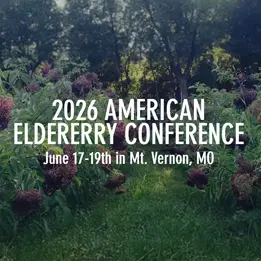
2026 AMERICAN ELDERERRY CONFERENCE

2026 AMERICAN ELDERERRY CONFERENCE

by
513 513 people viewed this event.

June 17-19th in Mt. Vernon, M

The American Elderberry Conference is a yearly event that takes place in the heart of the American elderberry farming world, right here in the Midwest! This conference brings together scientists working on the latest American elderberry research in health and lifestyle. It brings in farmers who travel in from across the globe to learn the latest techniques to increase production and build sustainably.  Included also are makers and innovators, who use American elderberries in various products available on the market.  The American Elderberry Conference provides valuable insight into the elderberry industry and helps connect American farmers with businesses.

June 17-19, 2026

2026 American Elderberry Conference

Building a Sustainable Future in Health, Agroforestry & Industry​​

Schedule:

Schedule:

Wednesday and Thursday we will be at The University of Missouri’s Southwest Research Extension and Education Center. Enjoy two days packed with information, lunch, snacks and vendors at the facility and we will tour their elderberry planting on Thursday. Presentations, presenters and schedule will be shared with ticket holders once finalized. Thursday evening, relax and network at the reception (more information coming soon). Friday, we will have a number of local elderberry farms available for you to tour.

The American Elderberry Conference is a yearly event that takes place in the heart of the American elderberry farming world, right here in the Midwest! This conference brings together scientists working on the latest American elderberry research in health and lifestyle. It brings in farmers who travel in from across the globe to learn the latest techniques to increase production and build sustainably.  Included also are makers and innovators, who use American elderberries in various products available on the market.  The American Elderberry Conference provides valuable insight into the elderberry industry and helps connect American farmers with businesses.

Each year the demand for elderberry products grow here in the USA. Elderberry researchers, farmers and product makers are on the forefront of this industry. Working together to unite and continue to build this marketable crop.  The yearly American Elderberry Conference digs deep into farming techniques and helps guide farmers to get the best yield for their acreage. This conference educates product makers building or using a processing facility, as well as creating value added products. It also brings in the latest research in areas such as American elderberry for brain health, diet and more. The conference focuses on the industry as a whole and how to build that: whether it be through product innovations, commercial farming techniques, community, marketing and more…

https://www.riverhillsharvest.com/2026-elderberry-conference

To register for this event please visit the following URL: https://www.riverhillsharvest.com/2026-elderberry-conference →


Date And Time

06-17-2026 to
06-19-2026
 

Location

Share With Friends

When Words Lose Their Meaning

Lionberry 's Weekly Delusion and Re-illusion Update.

The phrase “food is medicine” has become the wellness world’s version of “thoughts and prayers.” Everyone says it. Everyone feels good saying it. And almost nobody means anything real when they do. That’s the danger—not the phrase itself, but what happens when language gets stretched so far it stops pointing to anything true.

The original use of the phrase belonged to grandmas, gardeners, and people who still know how to cook and where food comes from. In that world, “food is medicine” meant something simple and grounded. A piece of meat and some vegetables—and fruit when it was in season—was just a regular meal. And then there were the special things you made when someone didn’t feel well: mixtures built from botanicals, herbs, fruits, nuts, grasses, roots, seeds, and whatever the land offered that season. Things pulled straight from soil and pantry because they carried function, flavor, and a purpose. That usage was peaceful, instinctive, and honest.

Then came the influencers, using the same phrase while holding something powdered, flavored, and algorithm-optimized. “Food is medicine” became a caption under a neon shake that tastes like peach sorbet and contains a clinically irrelevant amount of plant dust. They didn’t inherit the meaning—they inherited the hashtag. And hashtags don’t carry wisdom; they carry trend cycles.

Then comes the USDA, NIH, and hospital systems, who use both phrases—but in different ways. “Food Is Medicine” is their broad, public-facing concept, the umbrella idea that nutrition is foundational for health. “Food As Medicine”—capital As—is the technical term for the clinical, billing-coded interventions:

produce prescriptions,

medically tailored meals,

medically tailored groceries.

This version has insurance pathways, reimbursement logic, metrics, screenings, and outcome evaluations. It isn’t a belief system. It’s a healthcare program.

So we end up with two phrases—Food Is Medicine and Food As Medicine—that sound almost identical but function in totally different worlds. And both of them, at their best, once pointed to something we still have right now: real plants growing from real soil, carrying real chemistry that does real things in the human body. Not ancient in the sense of “long ago,” but ancient in the sense of continuity—still alive, still growing, still here.

Once a phrase becomes universal, though, it becomes meaningless.

That’s what’s happening now.

A wellness word printed on plastic.

“Natural” stamped on a bag of potato chips.

“Immune-supporting” slapped on anything that wants to look virtuous.

Marketing fog replacing actual meaning.

It’s Peacekeepers in 1984.

It’s “community” in Big Tech.

And on the Idiocracy side, it’s the fictional Electrolyte Drink Brawndo—marketed so aggressively that the entire population believes “it’s got what plants crave.”

In the film, they irrigate crops with the Electrolyte Drink Brawndo instead of water because advertising has replaced knowledge. Marketing departments tell us what truth is. The soil dies. The crops fail. The land collapses into a dust bowl. That’s what linguistic drift does: it hollows meaning until the absurd becomes normal.

“Food is medicine” used to mean:

eat real plants,

respect soil,

trust the chemistry that grows in the field,

trust the phytonutrients that come from this earth,

food keeps you alive and makes you whole.

Now it means turmeric dust on junk food.

Or a wellness word added so a product can sell for $3 more.

This hollowed-out category is not a comfortable place for real food to sit.

The old category, where LionBerry sits—the one before wellness gloss, before powdered fantasy, before language drift washed the meaning out of the words—still exists. But sitting there is not accidental. People tell me all the time to cheapen it, powder it, plastic-bottle it, isolate it, dilute it, lab-flavor it, margin-boost it, and make it “scalable” by stripping out the thing that makes it real.

I don’t do it.

Not because it’s easy.

But because sometimes the right thing to do is always the hardest thing to do.

LionBerry sits in the old category because I fight for it to sit there.

Real plants.

Real chemistry.

Real soil.

Real function.

Zero powdered fantasy.

LionBerry is exactly what it says it is: a farm-crafted drink made out of actual food.

When I say “the phrase doesn’t need to be fixed,” I mean the phrase “food is medicine.”

We don’t need to invent a new set of buzzwords or rescue the old ones from misuse.

We don’t need to rebuild or replace the language itself.

What needs to change is this:

start making products that mean what the words used to mean.

Start making food products that are just food