

Elderberry has a reputation problem. People try it and they say it kind of works. Sometimes. Maybe a little. That is not the berry’s fault. That is what got done to the berry long before it ever reached the bottle.
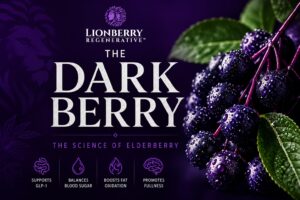
So let me start with what this berry can actually do when it is done right. We use the native American elderberry, Sambucus canadensis, fresh-pressed, and it carries roughly ten times the antioxidant punch of a blueberry. It is antiviral, and the anthocyanins are a big part of why, because they can grab onto the proteins a virus uses to get into your cells and gum up the works [11]. It works on your immune system the smart way, nudging the inflammatory signals up or down depending on what your body actually needs instead of just flooring the gas [11]. The anthocyanins feed the good bacteria in your gut like a prebiotic [4]. And when those bacteria break the anthocyanins apart, one of the main things they make is protocatechuic acid, which is the major thing your body turns cyanidin-3-glucoside into [12]. That little molecule slips across the blood-brain barrier and calms inflammation once it gets up there [12]. It works all the way from your gut up to your brain. It is past being a superfruit.
The problem is almost nobody ever gets that berry, because of what happens to it before it reaches them.
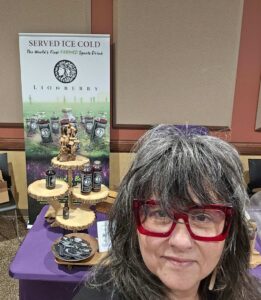
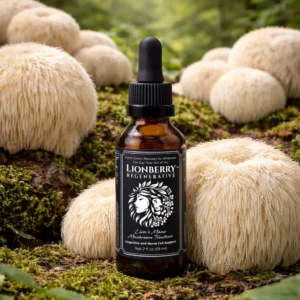
We make two products with elderberry. LIONBERRY REGENERATIVE™ HYDRATION and ELDERBERRY SIPS. Neither one is a syrup.
Syrup is fine for pancakes. Thicker is not better. When you cook elderberry down into a syrup you are not concentrating the medicine. You are boiling it off. What you have left is sugar and a sad story about what used to be in there.
Heat is the enemy. Long slow steeping, simmering the berry for hours with spices, that is not doing what people think it is doing. Dehydrating and powdering food changes the cell structure, takes too much heat, and burns off the delicate plant properties. So we do not use dehydrated powder.
Most powdered elderberry comes from overseas. Roughly 95% of the drugstore elderberry on the shelf is powdered European elderberry, Sambucus nigra, dried with heat [7]. The anthocyanins, those deep purple compounds that do the actual work, are fragile. Long heat destroys them [7]. By the time that powder is packed into a capsule the color is faded and the chemistry is gutted. And here is the thing people miss. The color is the medicine. When the purple is gone, the value went with it. A faded capsule is a receipt for something you no longer have.
Spray drying is worse. It shoots the material through hot air, so you get even more heat stress and even more loss [7]. And most of that overseas powder is the whole berry, seeds and all, which means you are grinding in the seed material and a heavier, muddier phytochemical profile than you ever get from clean juice. Juice leaves the seeds behind.
Here is where people get nervous, and where the American berry quietly wins. All elderberry, every species, carries some cyanogenic glycosides in the seeds and the unripe parts. Sambunigrin is the main one [9]. And yes, heat does knock those down. Cooking and heavy processing have been shown to cut cyanogenic glycoside levels way back [10]. That is the real reason so much elderberry, especially the European berry, gets cooked so hard. The higher cyanide load and old tradition push you straight toward heavy heat. But heavy heat is the exact thing that destroys the anthocyanins. So with the European berry you are boxed in. Cook it enough to feel safe and you cook the medicine right out of it.
American elderberry does not put you in that corner. It runs much lower in those compounds to begin with, and when researchers actually measured commercial American elderberry juice, they found no quantifiable trace of them [9]. That is exactly why we can press American elderberry, keep it as a juice, and never have to cook it into oblivion to make it safe. Low cyanide going in means we get to keep the heat low and the anthocyanins high. The European berry forces a choice between safe and potent. The American berry lets us have both.
But it is not just more. It is different. American elderberry carries acylated anthocyanins that European elderberry barely has, if it has them at all [1]. One of the big ones is a real mouthful. Cyanidin-3-O-[6-O-(E)-p-coumaroyl]sambubioside-5-O-glucoside. Forget the name. Remember the one word that matters. Acylated. That little acyl group is armor. It makes the molecule tougher against pH swings, against heat, against oxygen, against time sitting on a shelf [1]. And that armor is not a fun fact for a label. It is the whole reason the berry can do anything once it is inside you.
Most of these anthocyanins do not get absorbed up top in the stomach and the small intestine. That is not a problem. That is the plan. They are supposed to ride all the way down to the colon, because the colon is where the real work happens. The trouble is the colon is alkaline. The minute elderberry leaves the acid of the stomach and hits that alkaline stretch, a bare unprotected anthocyanin starts coming apart. The acyl armor is what holds it together long enough to arrive in one piece [1].
When it arrives, your own gut bugs go to work. Bifidobacterium especially. They take those anthocyanins apart and turn them into short-chain fatty acids and small phenolic compounds [4]. Those short-chain fatty acids are what talk to the L-cells in your gut lining, the same cells that run your body’s own GLP-1 signaling [4]. Elderberry does not contain GLP-1. It feeds the system that makes your own. That is the whole point. And it is worth saying that when the Washington State University team studied elderberry and saw the gut microbiome shift, fat oxidation climb, and glucose handling improve, they used elderberry juice [2]. Juice is the form the good data is sitting on.
So how you deliver it is not a small detail. A concentrated dry capsule and an acidified juice do not act the same once they hit your gut. So far, every time somebody lines up whole food against an isolated extract, the whole food comes out ahead [3]. There are not a lot of head-to-head studies yet, so I am not going to oversell it, but that is the way it keeps landing. A juice that is already acidified shows up in friendly shape. Low pH is exactly where anthocyanins are happiest, so more of them survive the trip and reach the colon intact, armor and all. A dry capsule has to dissolve, rehydrate, and tough out that alkaline run on its own, with no acid and no food around it to carry it through. Same berry on the label. Two completely different rides through your body.
This is why you never want to isolate one thing out and call it the answer. Plants work as a team. You would not send your eleven-man football squad onto the field, hand the ball to the tight end, and tell the other ten to sit down. He is not getting to the end zone by himself. He needs the line blocking and the backs running and everybody doing their job at the same time. Elderberry is the same way.
We evolved eating food. And the plants we eat evolved to defend themselves. So when we eat the plant, we are eating the very compounds it built to protect itself. Those compounds are sister molecules. Some of them mirror each other. Some of them work together. Some land on the same receptors, some land on different ones, and some of them flat out need each other just to become usable in your body at all. Pull one out of that lineup and you have got a tight end standing alone on the field wondering where his team went. Keep them together and they cover for each other. That is what a whole-food preparation does that a powdered isolate cannot.
LIONBERRY REGENERATIVE™ HYDRATION is more than a hydration drink. It is more than a sports recovery drink. It is metabolic recovery. It is GLP-1 friendly, built and optimized for GLP-1. It is for after you got your butt kicked, or after whatever it was that the day took out of you.
Think about what we hand athletes and kids. Sports drinks and energy drinks loaded with artificial color, sweeteners, powdered isolates, and caffeine. LIONBERRY is the other direction entirely. Not an energy drink. No isolates. No dehydrated powders. Real fruit, pressed, grown out of the ground by farmers.
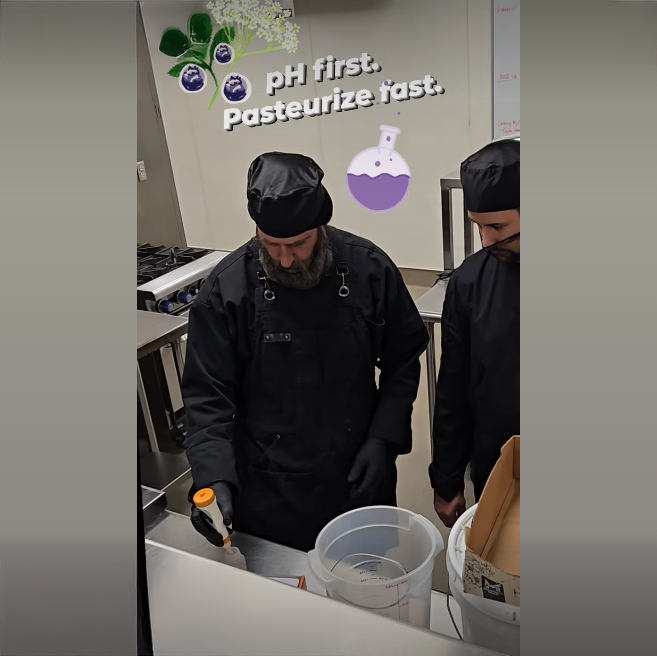
For LIONBERRY REGENERATIVE™ HYDRATION we start with a clear light base of elderflower tea, easy to drink, and we bring our elderberry to it. The anthocyanins are delicate. Long heat kills them. Dehydrating and spray drying kill them. So we engineer the pH first. We do not reduce it, we do not boil it, we do not cook it down into a syrup.
People brag about strange things. I have heard competitors boast that they never add a drop of water to their elderberry syrup. Good. I would hope not. Cooking elderberry down with honey and spices into a syrup is about as medicinal as making pancake syrup. The plant properties are gone. We do not make syrup.
Our second product is ELDERBERRY SIPS.
ELDERBERRY SIPS starts with fresh-pressed American elderberry juice. We additively bring in Concord grape for heart support and tart cherry for its melatonin and magnesium. Those are not afterthoughts. They earn their place. They also do something useful on the chemistry side. Together they pull the pH down to 3.7. That low pH protects the elderberry anthocyanins, and it does something else for us too. It shortens the pasteurization way down. About a minute at around 165°F. That is the whole window. And the acid is the reason. At 3.7 that short fast hold is exactly what our process authority signed off on. Quick heat, locked color, anthocyanins intact.
And yes, we use glass.
We hate hauling it. We are beasts of burden. It is heavy, it breaks, it is fragile, it costs a fortune to ship. Less-than-truckload freight is brutal. There are glass tariffs. But plastic leaches and aluminum cans are lined with plastic too, and healthy bodies deserve better than that.
Now here is the one way you can dry a berry without cooking the life out of it. Freeze drying. Freeze drying pulls the water out under vacuum at low temperature. No hot air. No reduction. No simmering it down. Done right it keeps the color, keeps the anthocyanins, keeps the heat-sensitive compounds that dehydration and spray drying murder [5][6]. For anything this rich in anthocyanins, freeze drying is the gold standard.
But done right is doing a lot of work in that sentence. You cannot just freeze dry juice and walk away. Two things have to be true.
First, you protect the anthocyanins with acid. They are most stable at low pH, so you bring the pH down and hold those purple compounds together through the whole process [8]. And not every acid is your friend here. Citric acid is. Ascorbic acid is not. Drop ascorbic acid into the water of the juice and it turns into hydrogen peroxide. Some people just call it bleaching, because that is what it looks like. It strips the color right out. And the color, again, is the medicine. So you use citric. You acidify first, then you dry.
Second, you carry it with acacia gum. Acacia gum, gum arabic, is a protective carrier. It shields the anthocyanins from oxygen, holds down moisture, and keeps the color and the chemistry steady in storage [5]. The powder ends up protected instead of sitting there naked and falling apart.
Citric acid to protect. Acacia gum to carry. Freeze dry, not spray dry, not dehydrate. That is the only way a powder ever earns its place near elderberry.
And that is where the work is headed next. Start with American elderberry juice. Bring in elderberry extract to push the anthocyanin content even higher while keeping that juice-derived profile. Protect it with citric acid. Carry it with acacia gum. Freeze dry the whole thing together. Juice plus extract, both freeze dried, the most good packed into the smallest honest package. Not whole seeded berry powder. Not a cooked-down reduction. The juice work, kept intact, in a form you can carry in your pocket.
When elderberry does not work, it is almost never the plant’s fault. It got overheated in dehydration. It got cooked down into a syrup. It got powdered and shipped in from overseas. It got handled until there was nothing left to handle. The reputation that elderberry only kind of works is a processing problem, not a plant problem.
Quality matters. Results matter. Temperature, water activity, and pH matter. And the color matters most of all, because the color is the proof that the medicine is still in there.
We want elderberry’s reputation higher than it is. We want better results. We want people honestly impressed, because it actually worked.
Do elderberry right.
References
[1] Lee J, Finn CE. Anthocyanins and Other Polyphenolics in American Elderberry (Sambucus canadensis) and European Elderberry (Sambucus nigra). USDA Agricultural Research Service. https://www.ars.usda.gov/ARSUserFiles/1718/pdf/2007/anthocyaninsandotherpolyphenolicsinamericanelder.pdf
[2] Solverson et al. Nutrients. 2024. https://pmc.ncbi.nlm.nih.gov/articles/PMC11510622/
[3] Kumkum R, Aston-Mourney K, McNeill BA, Hernández D, Rivera LR. Bioavailability of Anthocyanins: Whole Foods versus Extracts. Nutrients. 2024. https://www.ncbi.nlm.nih.gov/pmc/articles/PMC11123854/
[4] A Review of Factors Affecting Anthocyanin Bioavailability: Possible Implications for the Inter-Individual Variability. Nutrients. https://pmc.ncbi.nlm.nih.gov/articles/PMC7023094/
[5] Baeza et al. Food Science and Technology International. 2021. https://pubmed.ncbi.nlm.nih.gov/32659122/
[6] Brønnum-Hansen & Flink. International Journal of Food Science and Technology. 1985.
[7] Anthocyanin Content and Storage Stability Studies. https://repositorio.uca.edu.ar/bitstream/123456789/13862/1/anthocyanin-content-storage-stability.pdf
[8] Kaack K. Processing of Anthocyanin Colourant from Elderberry Using Citric Acid. https://dcapub.au.dk/pub/planteavl_94_423.pdf
[9] Cyanogenic Glycoside Analysis in American Elderberry. Molecules. 2021. (No quantifiable cyanogenic glycosides found in commercial American elderberry juice.) https://pmc.ncbi.nlm.nih.gov/articles/PMC7961730/
[10] Senica M, et al. Processed elderberry (Sambucus nigra L.) products: A beneficial or harmful food alternative? (Heat processing reduced cyanogenic glycosides up to 96%.) https://www.sciencedirect.com/science/article/abs/pii/S002364381630247X
[11] Elderberry for Prevention and Treatment of Viral Respiratory Illnesses: A Systematic Review. (Antiviral action via anthocyanins binding viral glycoproteins; modulation of inflammatory cytokines.) https://www.ncbi.nlm.nih.gov/pmc/articles/PMC8026097/
[12] Protocatechuic acid, the major metabolite of cyanidin-3-glucoside: blood-brain barrier permeability and anti-inflammatory, neuroprotective activity. https://www.ncbi.nlm.nih.gov/pmc/articles/PMC5504963/ and https://pmc.ncbi.nlm.nih.gov/articles/PMC11478363/