Lit From Within: An Upcycled LIONBERRY Bottle

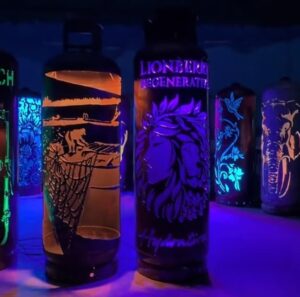
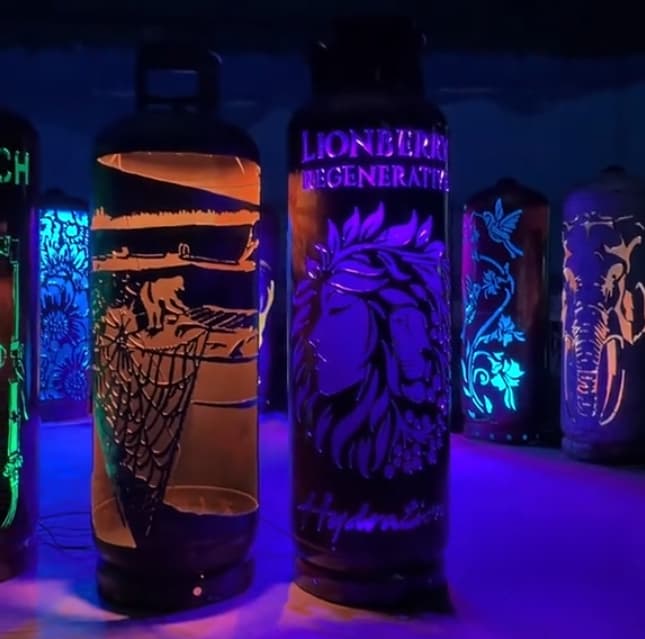
There’s a six-foot bottle of LIONBERRY REGENERATIVE HYDRATION on its way to Kansas from Canada. It used to be a water heater.

Dave — the artist behind Theeupcycler Metal Art, based in Wetaskiwin, Alberta — takes things the world throws away and gives them a second life. Old water heaters. Car parts. Scrap steel. With a torch, an eye, and a deep respect for what a discarded object can still become, he turns industrial cast-offs into art.

When Dave looked at a six-foot water heater, he saw a bottle. Our bottle. He cut the LIONBERRY logo straight into the steel — the lion, the one — and set a purple light inside. At night, the whole thing glows elderberry. A hand-cut, fire-and-steel LIONBERRY bottle, lit from within, born from something that was headed for the scrap pile.

It’s shipping down from Alberta this summer to help us welcome the world. With the World Cup bringing visitors from every corner of the planet to the heartland, we wanted something that told the LIONBERRY story without saying a word: farm-rooted, clean-label, nothing wasted, nothing synthetic, everything given a second life. An upcycled bottle for a regenerative brand. It fits.

Dave’s work is about honoring what already exists — the steel, the shape, the history of the object — and coaxing something new out of it. That’s the same ethic behind LIONBERRY. We don’t formulate in a lab. We grow, press, and bottle what the land already offers, and we try to waste none of it. Elderberries the birds didn’t get. Honey from hives down the road. Lion’s mane from a Missouri mushroom farm. Butterfly pea flower for the color the earth already knows how to make.

A water heater reborn as a glowing elderberry bottle is, maybe, the most honest piece of brand art we could have asked for. Thank you, Dave. We can’t wait to stand next to it this summer as we welcome the WORLDS CUP AND FIFA TO KANSAS CITY and watch people’s faces when they realize what it used to be!

Facebook
X
LinkedIn

Presentation at the Great Plains Growers Conference

Lionberry 's Weekly Delusion and Re-illusion Update.

Heartland Elderberry Collaborative (Heartland ECo)


“Instead of asking each farm to grow bigger, we’re building shared capacity so farms can stay viable at their current scale while accessing value-added markets.”

An AgriCluster Pilot for Shared Infrastructure and Value-Added Market Access
Eastern Kansas / Western Missouri


PROBLEM CONTEXT

Small and mid-sized farms face persistent structural barriers to entering value-added markets, including:

• Limited access to processing infrastructure
• Limited cold storage capacity
• Transportation constraints
• Fragmented, uncoordinated distribution
• High costs from duplicating equipment and logistics across individual farms

These constraints restrict grower profitability, inhibit vertical integration, and reduce the viability of diversified regional food systems.


WHAT HEARTLAND ECo IS

The Heartland Elderberry Collaborative (Heartland ECo) is an active, facilitated, place-based AgriCluster pilot organizing elderberry growers and processors in eastern Kansas and western Missouri.

• Facilitated through ACRE (AgriCluster Resilience and Expansion)
• Emphasizes collective capacity-building and shared infrastructure
• Designed to enable farm-level vertical integration (grow, process, and take products to market)
• Structured to share infrastructure, governance, and market access


WHAT HEARTLAND ECo IS NOT

• Not a single-farm expansion program
• Not a commodity-scale production model
• Not a vertically integrated corporate system


WHY ELDERBERRY

• Performs well on marginal soils
• Integrates with soil-health and regenerative practices
• Supports perennial hedgerows and diversified systems
• Enables multiple value-added pathways (destemming, juicing, beverage and supplement production)
• Aligns with growing consumer demand for regionally produced products

The pilot is explicitly designed to test repeatability across additional non–Big Ag crops, including tomatoes, fruit crops, and legumes.


CURRENT PILOT STATUS

• Core grower group established
• Regular coordination underway
• Shared infrastructure priorities identified
• Grower recruitment initiated
• Early coordination with grocery buyers in progress


SHARED INFRASTRUCTURE HUB CONCEPT

The Heartland ECo model proposes a centralized hub facility located south of Kansas City to support participating farms and processors.

• Aggregation and intake
• Cold storage
• Destemming
• Juicing
• Bottling
• Short-haul regional distribution

The hub is intended to reduce duplicated equipment costs, logistical inefficiencies, and fragmented distribution efforts that commonly limit small-farm participation in value-added markets.


PILOT OBJECTIVES

Establish a functioning elderberry AgriCluster
Create shared access to processing, storage, and distribution infrastructure
Build collective grant-writing and fundraising capacity
Coordinate educational outreach related to elderberry and soil-health practices
Evaluate feasibility of scaling the model across additional crops and regions


FORTHCOMING PILOT STUDY

This poster outlines a proposal for a forthcoming pilot study to formally evaluate the effectiveness of the Heartland ECo model.

• Economic impact
• Grower profitability
• Infrastructure utilization
• Soil-health indicators
• Logistical efficiency
• Replicability across crops and regions

DOWNLOAD POSTER HERE