Lit From Within: An Upcycled LIONBERRY Bottle

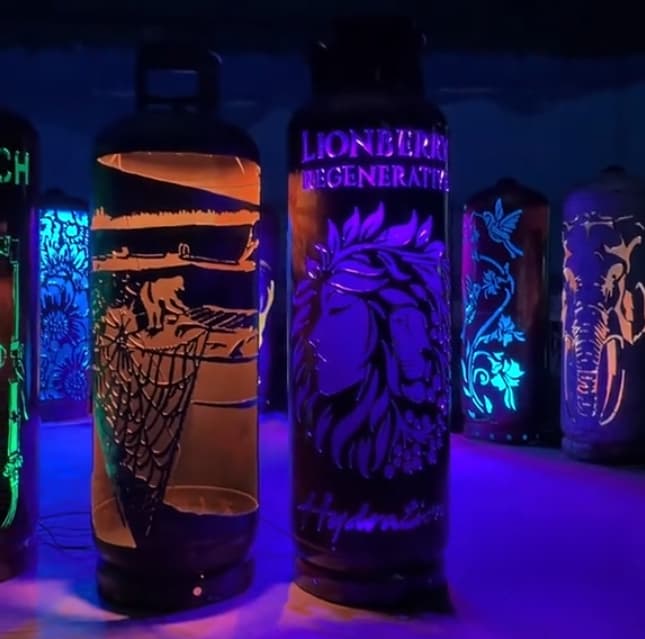
There’s a six-foot bottle of LIONBERRY REGENERATIVE HYDRATION on its way to Kansas from Canada. It used to be a water heater.

Dave — the artist behind Theeupcycler Metal Art, based in Wetaskiwin, Alberta — takes things the world throws away and gives them a second life. Old water heaters. Car parts. Scrap steel. With a torch, an eye, and a deep respect for what a discarded object can still become, he turns industrial cast-offs into art.

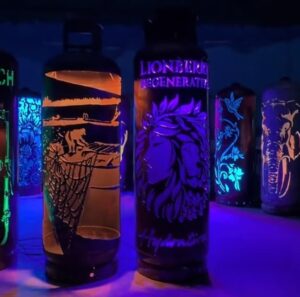
When Dave looked at a six-foot water heater, he saw a bottle. Our bottle. He cut the LIONBERRY logo straight into the steel — the lion, the one — and set a purple light inside. At night, the whole thing glows elderberry. A hand-cut, fire-and-steel LIONBERRY bottle, lit from within, born from something that was headed for the scrap pile.

It’s shipping down from Alberta this summer to help us welcome the world. With the World Cup bringing visitors from every corner of the planet to the heartland, we wanted something that told the LIONBERRY story without saying a word: farm-rooted, clean-label, nothing wasted, nothing synthetic, everything given a second life. An upcycled bottle for a regenerative brand. It fits.

Dave’s work is about honoring what already exists — the steel, the shape, the history of the object — and coaxing something new out of it. That’s the same ethic behind LIONBERRY. We don’t formulate in a lab. We grow, press, and bottle what the land already offers, and we try to waste none of it. Elderberries the birds didn’t get. Honey from hives down the road. Lion’s mane from a Missouri mushroom farm. Butterfly pea flower for the color the earth already knows how to make.

A water heater reborn as a glowing elderberry bottle is, maybe, the most honest piece of brand art we could have asked for. Thank you, Dave. We can’t wait to stand next to it this summer as we welcome the WORLDS CUP AND FIFA TO KANSAS CITY and watch people’s faces when they realize what it used to be!


Facebook
X
LinkedIn

Elderberry’s Reputation Problem Doing It Right So It Actually Works

Lionberry 's Weekly Delusion and Re-illusion Update.

We make two products with elderberry: LionBerry Regenerative Hydration and Elderberry Sips. Neither one is a syrup.

Syrup is fine for pancakes. Thicker is not better.

For elderberry — as food, as medicine, for maximum benefit — drop the pH, pasteurize fast, protect plant properties, no powders.

Long, slow steeping in heat — like simmering elderberry with spices for hours — is not better. Powder is fine for powdered sugar, powdered snow, and baby powder — but not elderberry. There is no place for powder in food. Dehydrating and powdering food changes cell structure, uses too much heat, and burns off delicate plant properties.

We never use dehydrated powder. Most powdered elderberry comes from overseas. About 95% of drugstore elderberry products rely on powdered European elderberry.

We use the native American elderberry — Sambucus canadensis, fresh-pressed. American elderberry contains dramatically higher levels of anthocyanins — the purple antioxidants — roughly 10× the antioxidant activity of blueberries, for perspective. It’s beyond a superfruit. It also has antiviral activity and supports gut health and immune modulation.

LionBerry Regenerative Hydration is more than a sports drink. It’s a recovery drink — for after you got your butt kicked, or for whatever it is that life did to you.

It’s strange what we give athletes and kids: sports drinks and energy drinks loaded with artificial colors, sweeteners, powdered isolates, and caffeine. LionBerry is the opposite. Not an energy drink. No isolates. No powders. Whole plants, intact, grown out of the ground by farmers.

Plants work through synergy. Their compounds evolved to function together. Isolating one molecule misses the point.

For LionBerry Regenerative Hydration, we start with a clear, light base of elderflower tea — easily drinkable — and add it to our elderberry. The anthocyanins in elderberry are delicate. Long heat destroys them. Repeated freezing and thawing destroys them. Powdering destroys them.

Mass spectrometry consistently shows that whole-food preparations retain broader nutritional complexity than powders or isolates. Dehydration and reduction require too much heat — the plant properties burn off.

We engineer pH first — not reduction, not boiling, not cooking it down into a syrup.

Elderberry starts around pH 5.1. That’s too high for safe bottling.

People brag about odd things. I have heard competitors advertise that they never add water to their elderberry syrup. Good. I should hope not.

Making an elderberry syrup is about as medicinal as making pancake syrup. Making syrup is traditionally done by cooking elderberry down with honey and spices. That’s worse than adding water. The plant properties are all gone.

To preserve plant properties, you need to drop the pH to prevent botulism, preserve anthocyanins, and proceed with a hot fill, hold, and then hermetically seal — without boiling the plant into oblivion.

We don’t make syrup.

Our second product is Elderberry Sips — that’s the name. Capital E. Capital S. Plural.

Elderberry Sips uses fresh-pressed elderberry — never powder, never concentrate. We add Concord grape ( RESERVITOL-heart support) and tart cherry (melatonin & magnesium). Together they naturally drop the pH to ~3.7, allowing fast pasteurization without heat that causes degradation of purple elderberry anthocyanins The lower pH protects the delicate plant properties. Elderberry Sips is ~15% tart cherry and Concord Grape added to fresh pressed American Elderberry — without gallons of honey and without turning it into a syrup sugar bomb.

A syrup is defined as ~60% solids. To get there, you must boil and reduce. That process destroys anthocyanins.

Cinnamon is great — but it needs long, hot steeping. Elderberry needs fast, controlled heat. They are biologically opposite processes.

And yes, we use glass. We hate hauling it. We are beasts of burden. It’s heavy. It breaks. It’s fragile. It’s expensive to ship. Less-than-truckload shipping is brutal. There are glass tariffs.

But plastic leaches. Aluminum has plastic liners. And healthy bodies deserve better.

We don’t water down syrup. We don’t confuse chemistry with marketing.

We don’t want anyone out of business. We want elderberry done right.

When elderberry “doesn’t work,” it’s usually not the plant’s fault — it’s been overheated in dehydration, over-reduced in making a syrup, powdered and shipped from overseas, repeatedly frozen and thawed, or cooked into oblivion.

Quality matters. Results matter. Temperature, water activity, and pH matter.

We want elderberry’s reputation to be higher. We want better results. We want people impressed because it actually works.

Do elderberry right.