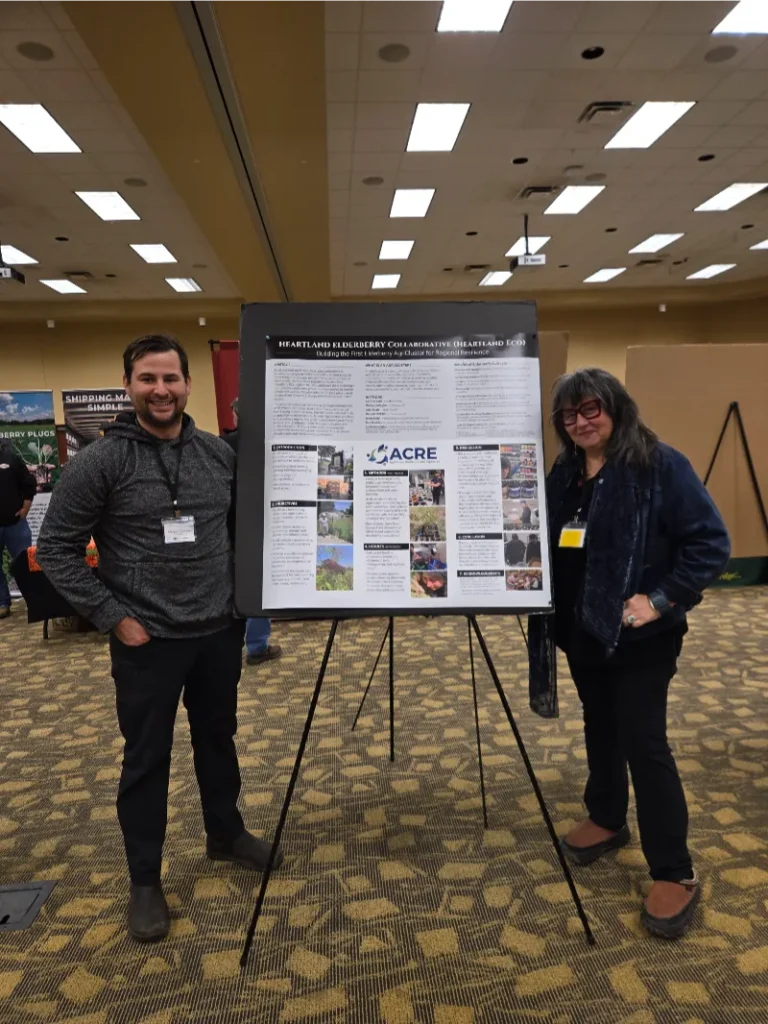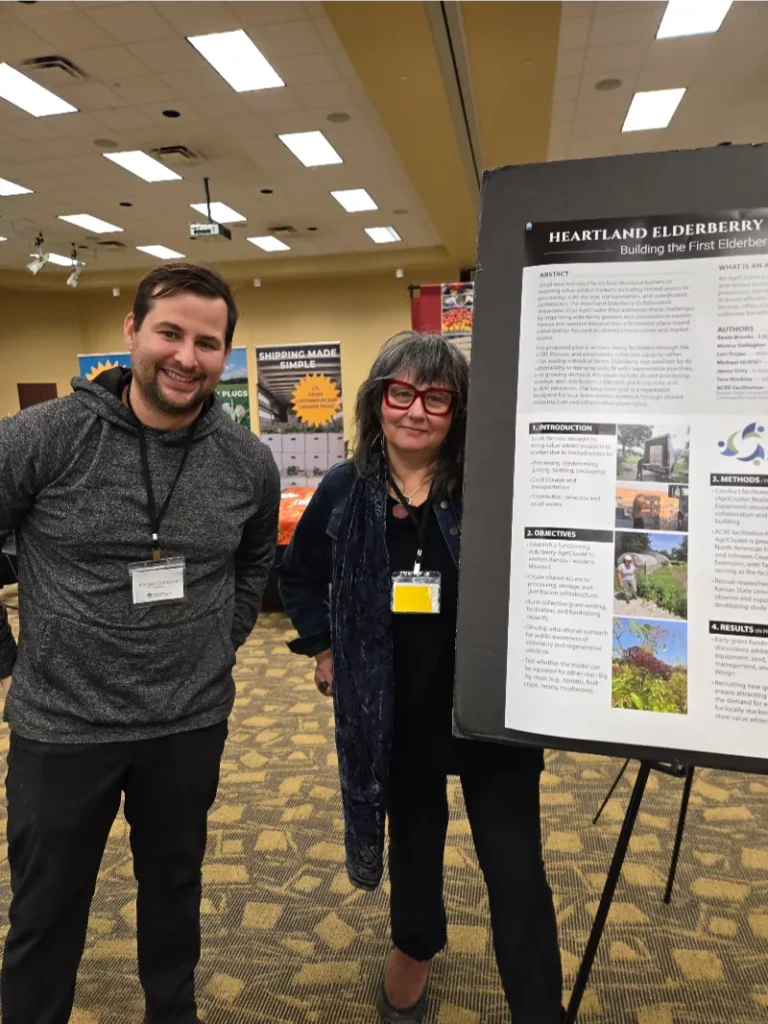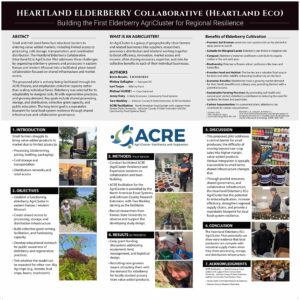
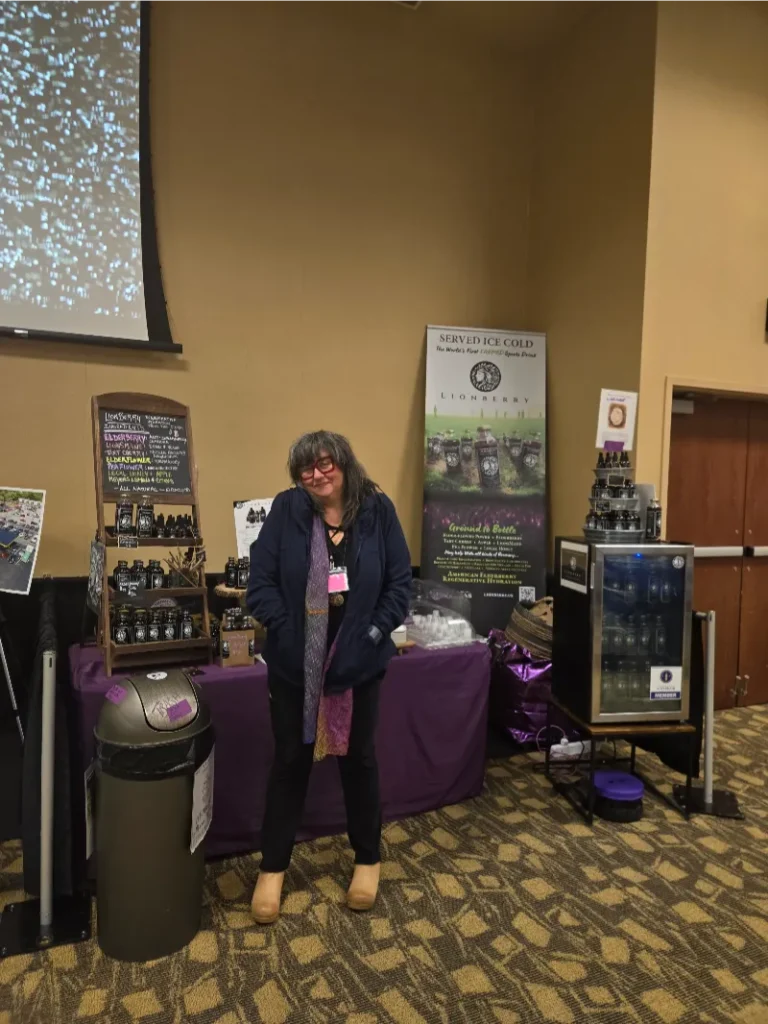
Poster Presentation at the Great Plains Growers Conference

We make two products with elderberry: LIONBERRY Regenerative Hydration and Elderberry Sips. Neither one is a syrup.

Syrup is fine for pancakes. Thicker is not better.

For elderberry — as food, as medicine, for maximum benefit — drop the pH, pasteurize fast, protect plant properties, no powders.

Long, slow steeping in heat — like simmering elderberry with spices for hours — is not better. Powder is fine for powdered sugar, powdered snow, and baby powder — but not elderberry. There is no place for powder in food. Dehydrating and powdering food changes cell structure, uses too much heat, and burns off delicate plant properties.

We never use dehydrated powder. Most powdered elderberry comes from overseas. About 95% of drugstore elderberry products rely on powdered European elderberry.

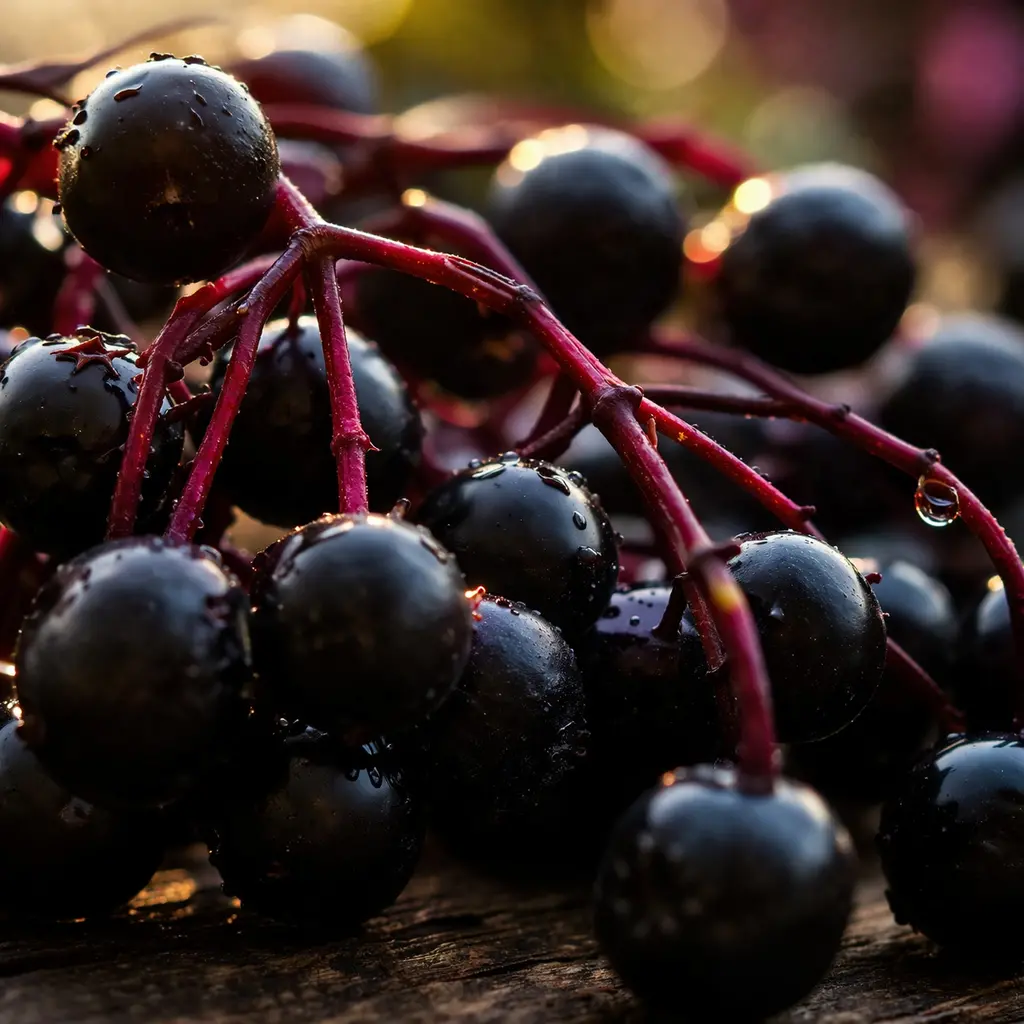
We use the native American elderberry — Sambucus canadensis, fresh-pressed. American elderberry contains dramatically higher levels of anthocyanins — the purple antioxidants — roughly 10× the antioxidant activity of blueberries, for perspective. It’s beyond a superfruit. It also has antiviral activity and supports gut health and immune modulation.

LIONBERRY Regenerative Hydration is more than a sports drink. It’s a recovery drink — for after you got your butt kicked, or for whatever it is that life did to you.

It’s strange what we give athletes and kids: sports drinks and energy drinks loaded with artificial colors, sweeteners, powdered isolates, and caffeine. LIONBERRY is the opposite. Not an energy drink. No isolates. No powders. Whole plants, intact, grown out of the ground by farmers.

Plants work through synergy. Their compounds evolved to function together. Isolating one molecule misses the point.

For LIONBERRY Regenerative Hydration, we start with a clear, light base of elderflower tea — easily drinkable — and add it to our elderberry. The anthocyanins in elderberry are delicate. Long heat destroys them. Repeated freezing and thawing destroys them. Powdering destroys them.

Mass spectrometry consistently shows that whole-food preparations retain broader nutritional complexity than powders or isolates. Dehydration and reduction require too much heat — the plant properties burn off.

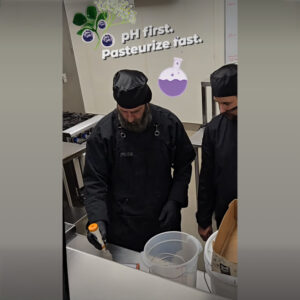
We engineer pH first — not reduction, not boiling, not cooking it down into a syrup.

Elderberry starts around pH 5.1. That’s too high for safe bottling.

People brag about odd things. I have heard competitors advertise that they never add water to their elderberry syrup. Good. I should hope not.

Making an elderberry syrup is about as medicinal as making pancake syrup. Making syrup is traditionally done by cooking elderberry down with honey and spices. That’s worse than adding water. The plant properties are all gone.

To preserve plant properties, you need to drop the pH to prevent botulism, preserve anthocyanins, and proceed with a hot fill, hold, and then hermetically seal — without boiling the plant into oblivion.

We don’t make syrup.

Our second product is Elderberry Sips — that’s the name. Capital E. Capital S. Plural.

Elderberry Sips uses fresh-pressed elderberry — never powder, never concentrate. We add Concord grape (RESERVITOL – heart support) and tart cherry (melatonin & magnesium). Together they naturally drop the pH to ~3.7, allowing fast pasteurization without heat that causes degradation of purple elderberry anthocyanins. The lower pH protects the delicate plant properties. Elderberry Sips is ~15% tart cherry and Concord grape added to fresh-pressed American elderberry — without gallons of honey and without turning it into a syrup sugar bomb.

A syrup is defined as ~60% solids. To get there, you must boil and reduce. That process destroys anthocyanins.

Cinnamon is great — but it needs long, hot steeping. Elderberry needs fast, controlled heat. They are biologically opposite processes.


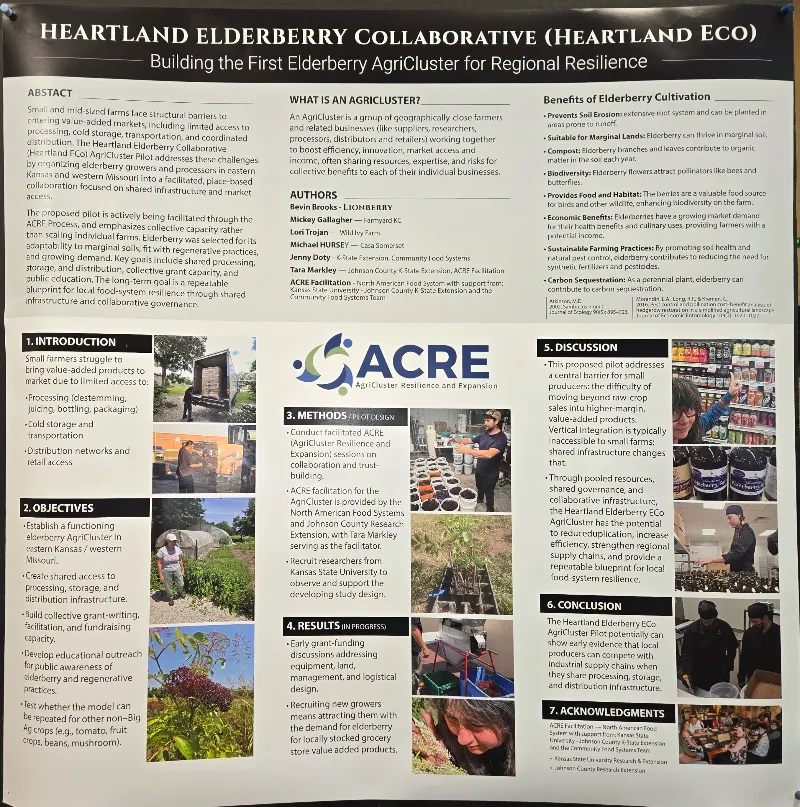
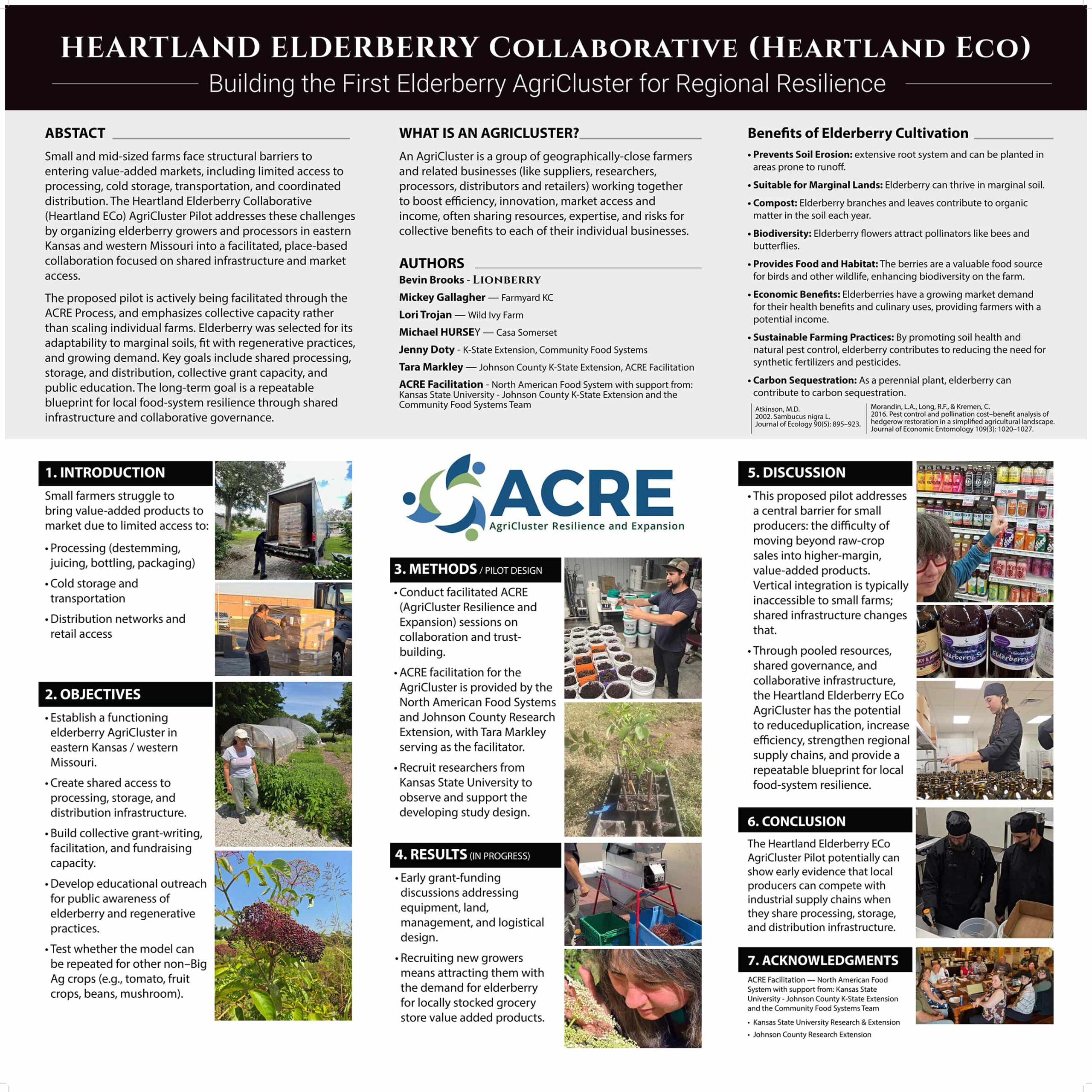
Heartland Elderberry Collaborative (Heartland ECo)


“Instead of asking each farm to grow bigger, we’re building shared capacity so farms can stay viable at their current scale while accessing value-added markets.”

An AgriCluster Pilot for Shared Infrastructure and Value-Added Market Access
Eastern Kansas / Western Missouri


PROBLEM CONTEXT

Small and mid-sized farms face persistent structural barriers to entering value-added markets, including:

• Limited access to processing infrastructure
• Limited cold storage capacity
• Transportation constraints
• Fragmented, uncoordinated distribution
• High costs from duplicating equipment and logistics across individual farms

These constraints restrict grower profitability, inhibit vertical integration, and reduce the viability of diversified regional food systems.


WHAT HEARTLAND ECo IS

The Heartland Elderberry Collaborative (Heartland ECo) is an active, facilitated, place-based AgriCluster pilot organizing elderberry growers and processors in eastern Kansas and western Missouri.

• Facilitated through ACRE (AgriCluster Resilience and Expansion)
• Emphasizes collective capacity-building and shared infrastructure
• Designed to enable farm-level vertical integration (grow, process, and take products to market)
• Structured to share infrastructure, governance, and market access


WHAT HEARTLAND ECo IS NOT

• Not a single-farm expansion program
• Not a commodity-scale production model
• Not a vertically integrated corporate system


WHY ELDERBERRY

• Performs well on marginal soils
• Integrates with soil-health and regenerative practices
• Supports perennial hedgerows and diversified systems
• Enables multiple value-added pathways (destemming, juicing, beverage and supplement production)
• Aligns with growing consumer demand for regionally produced products

The pilot is explicitly designed to test repeatability across additional non–Big Ag crops, including tomatoes, fruit crops, and legumes.


CURRENT PILOT STATUS

• Core grower group established
• Regular coordination underway
• Shared infrastructure priorities identified
• Grower recruitment initiated
• Early coordination with grocery buyers in progress


SHARED INFRASTRUCTURE HUB CONCEPT

The Heartland ECo model proposes a centralized hub facility located south of Kansas City to support participating farms and processors.

• Aggregation and intake
• Cold storage
• Destemming
• Juicing
• Bottling
• Short-haul regional distribution

The hub is intended to reduce duplicated equipment costs, logistical inefficiencies, and fragmented distribution efforts that commonly limit small-farm participation in value-added markets.


PILOT OBJECTIVES

Establish a functioning elderberry AgriCluster
Create shared access to processing, storage, and distribution infrastructure
Build collective grant-writing and fundraising capacity
Coordinate educational outreach related to elderberry and soil-health practices
Evaluate feasibility of scaling the model across additional crops and regions


FORTHCOMING PILOT STUDY

This poster outlines a proposal for a forthcoming pilot study to formally evaluate the effectiveness of the Heartland ECo model.

• Economic impact
• Grower profitability
• Infrastructure utilization
• Soil-health indicators
• Logistical efficiency
• Replicability across crops and regions

DOWNLOAD POSTER HERE
Facebook
X
LinkedIn

Fortifying the Heartland: My Christmas Wish for Hy-Vee.

Lionberry 's Weekly Delusion and Re-illusion Update.

This week’s delusion is pretending our grocery stores don’t have a weak point.

This week’s re-illusion is remembering that strength comes from building on what already works, not acting like we’re starting from scratch.

Hy-Vee does a really good job bringing in local barbecue sauces, jams, honey, and other value-added foods from the Heartland.

We’re not starting from zero.

But we are starting from small.

So I handed Santa a LionBerry and gave him my Christmas list:

A fortified Hy-Vee — one that expands the Heartland section that already exists into a full, accessible, stocked-every-day aisle for local foods.

Not to replace the global or national imports like Florida oranges, California almonds, Mexico avocados, pineapple juice from Thailand, or coastal produce —

but to stand beside them, so the region isn’t left vulnerable the next time anything shakes the system:

  • fuel shortages
  • war
  • trucking strikes
  • geopolitics
  • water shortages
  • drought or dust-bowl conditions
  • port disruptions
  • cyber hits
  • natural disasters

Any one of these can break a supply chain.

A fortified regional shelf — built from the farms around Kansas, Missouri, and Nebraska — keeps us fed.

The World Cup is coming to Kansas City.

Soccer tourists from Germany, Brazil, Japan, everywhere — living in Airbnbs for three to six weeks, shopping at Hy-Vee for everything from breakfast to body soap.

If we went to Germany, we’d want Wienerschnitzel.

If we went to Brazil, we’d want feijoada.

If we went to Japan, we’d want ramen or sushi that actually tastes like Japan.

So when they come to the Heartland, they don’t want a New York hot dog or a California cheeseburger.

They want us — the real Midwest.

What do we grow and make here?

  • local barbecue sauces
  • local fruit like blueberries
  • corn tortillas, tomato sauces, and beans
  • wheat pastas and breads
  • value-added soaps made from beef tallow
  • local meat, dairy, and eggs
  • elderberry drinks

And soccer tourists staying in AirBnB’s need actual essentials:

  • dish soap
  • cleaning agents
  • body soap and hygiene products
  • breakfast foods
  • snacks
  • drinks
  • basics
  • dinners

This is exactly why a stronger Heartland aisle matters — not just for crisis, but for culture, tourism, and everyday life.

This week’s delusion is pretending our grocery stores don’t have a weak point.
This week’s re-illusion is remembering that strength comes from building on what already works, not acting like we’re starting from scratch.

Hy-Vee does a really good job bringing in local barbecue sauces, jams, honey, and other value-added foods from the Heartland.
We’re not starting from zero.
But we are starting from small.

So I handed Santa a LionBerry and gave him my Christmas list:

A fortified Hy-Vee — one that expands the Heartland section that already exists into a full, accessible, stocked-every-day aisle for local foods.

Not to replace the global or national imports like Florida oranges, California almonds, Mexico avocados, pineapple juice from Thailand, or coastal produce —
but to stand beside them, so the region isn’t left vulnerable the next time anything shakes the system:

  • fuel shortages
  • war
  • trucking strikes
  • geopolitics
  • water shortages
  • drought or dust-bowl conditions
  • port disruptions
  • cyber hits
  • natural disasters

Any one of these can break a supply chain.
A fortified regional shelf — built from the farms around Kansas, Missouri, and Nebraska — keeps us fed.

The World Cup is coming to Kansas City.
Soccer tourists from Germany, Brazil, Japan, everywhere — living in Airbnbs for three to six weeks, shopping at Hy-Vee for everything from breakfast to body soap.

If we went to Germany, we’d want Wienerschnitzel.
If we went to Brazil, we’d want feijoada.
If we went to Japan, we’d want ramen or sushi that actually tastes like Japan.

So when they come to the Heartland, they don’t want a New York hot dog or a California cheeseburger.
They want us — the real Midwest.

What do we grow and make here?

  • local barbecue sauces
  • local fruit like blueberries
  • corn tortillas, tomato sauces, and beans
  • wheat pastas and breads
  • value-added soaps made from beef tallow
  • local meat, dairy, and eggs
  • elderberry drinks

And soccer tourists staying in Airbnbs need actual essentials:

  • dish soap
  • cleaning agents
  • body soap and hygiene products
  • breakfast foods
  • snacks
  • drinks
  • basics
  • dinners

This is exactly why a stronger Heartland aisle matters — not just for crisis, but for culture, tourism, and everyday life.

A shared warehouse, a shared distributor, and a unified block of local makers would let regional foods move with the same efficiency as national brands — while staying rooted right here.

Tourists will buy it.
Locals will keep it.
And if anything ever shakes the world, a fortified Hy-Vee keeps the Heartland standing.

That’s what I told Santa.
That’s my wish this year.
And that’s exactly what LionBerry is built to help do — bottle by bottle, aisle by aisle.