Questions & Answers

A collection of Q&A sessions about Lionberry products, American elderberry, and Lion’s Mane mushroom. 

Disclaimer: This video is for entertainment and educational purposes only. It is not medical advice, nor should it be treated as such. If you need medical advice, please consult a real, licensed professional who probably wears a stethoscope more often than I do.

Also, for the record: this video was filmed on a very tall table. I do have big feet, but no — I am not a hobbit. Please don’t ask me about Second Breakfast.

Rather Read?  

The Power of American Elderberry:

Local Roots, Global Impact

In this Q&A, the speaker explains the health benefits of elderberry, including compounds like protocatechuic acid, quercetin, and Omega-3s for brain health. They highlight the importance of American elderberry as a native Midwest crop, discuss cultivars grown in Kansas and Missouri, and stress the need for a strong local supply chain to replace reliance on European elderberry imports. Elderberry is presented not only as a health resource but also as a regenerative farming solution that supports soil health, biodiversity, carbon sequestration, and additional revenue for farmers.

Food as Medicine:

Elderberry, Lion’s Mane, and Soil Health

In this short Q&A, the speaker emphasizes that food functions as medicine, supporting the immune system, reducing inflammation, and improving gut health. Lion’s mane mushroom is highlighted for its role in regenerative nerve health, while elderberry is praised both for its health benefits and for its contribution to regenerative agriculture. Elderberry is described as valuable not only for human wellness but also for building healthier soil.

Lion’s Mane Extract:

Brain Health and Nerve Regeneration

In this Q&A, the speaker explains the powerful properties of Lion’s Mane mushroom extract. A double extraction process captures compounds from both the fruiting body and mycelium, providing precursors to nerve growth factor (NGF) and brain-derived neurotrophic factor (BDNF). These compounds support nerve regeneration and brain health, helping to counter the natural decline from aging, depression, or illness. While Lion’s Mane can be eaten fresh, concentrated tinctures make it easier to obtain therapeutic levels of phytonutrients. The extract is commonly added to coffee, tea, or smoothies, forming a key component of the Lionberry product alongside elderberry.

Getting Started with Elderberry:

Drinks or Concentrates

The speaker introduces ways to begin with elderberry products, depending on personality and preference. Some may prefer a daily teaspoon of concentrated elderberry, while others might try a four-pack of elderberry drinks. Both options are tasty, with flavors reminiscent of grape and tart cherry. The discussion emphasizes that food has always been medicine—supporting health and forming part of regenerative agriculture practices—reminding us that eating well is both a personal and ecological choice.

Why Take Elderberry?

Antioxidants and Inflammation Support

In this Q&A, the speaker explains why elderberry is such a popular health food. Elderberries contain exceptionally high levels of antioxidants, particularly anthocyanins—the compounds responsible for the deep purple color of many fruits. Ranking among the top fruits for anthocyanin content (second only to chokeberry), elderberry provides powerful support against inflammation. The antioxidants break down into beneficial metabolites such as protocatechuic acid, which further contribute to health benefits.

When Will I Notice Results from Lion’s Mane?

In this Q&A, the speaker explains that while Lion’s Mane is not medical advice but rather a functional food, many people report benefits within one to three weeks of regular use. Research suggests men may feel effects slightly faster than women. Taken daily, even in small amounts such as two milliliters, Lion’s Mane is being explored for supporting everything from senior cognitive decline to ADHD in younger generations. The speaker predicts that within a few years, Lion’s Mane will become a household staple—fortifying drinks much like calcium in orange juice or iodine in salt—making products like Lionberry a natural fit for everyday wellness.

Will Picky Kids Like the Taste of Elderberry?

In this Q&A, the speaker emphasizes that elderberry drinks were designed with picky kids—and adults—in mind. Thanks to flavors like Concord grape, tart cherry, honey, and lemon, the drinks taste more like natural sports beverages such as Pedialyte or Gatorade, rather than bitter or spicy herbal blends. While subtle undertones of elderberry and elderflower tea remain, the flavor profile is light, fruity, and appealing, making it enjoyable for even the fussiest palates.

Lion’s Mane Extract and Nerve Growth Support

In this Q&A, the speaker describes Lion’s Mane mushroom extract, a powerful double extraction made with both alcohol and water at Meyers Mushrooms in the Midwest. The tincture includes compounds from both the fruiting body and the mycelium, which stimulate nerve growth factor (NGF) and brain-derived neurotrophic factor (BDNF). These compounds act like “miracle grow” for nerve branches, supporting regeneration that naturally declines with age, depression, stroke, or other conditions. Research on Lion’s Mane is robust, confirming its role in promoting nerve health and cognitive support.

Building a Local Value Chain:

Kansas State Fair

In this Q&A, the speaker shares their excitement about showcasing products at the Kansas State Fair. They describe their “24-farm value chain,” which connects local producers including Meyers Mushrooms, Shoney Honey, Elder Farms, and Bueller Organics. This network supports juicing, elderberry extract, and other inputs, ensuring that money spent locally is reinvested in the community. The speaker emphasizes the multiplier effect of recirculating dollars through local farms and plans to invite collaborators and guest speakers to their booth to engage directly with the community.

Elderberry Products and Low-Sugar Options

In this Q&A, the speaker addresses whether their products are suitable for people following low-sugar or keto lifestyles. All products use local raw Shoney honey as a natural sweetener, with no added or processed sugars. While this means they are not calorie-free, they remain free of refined sugar. For those who want elderberry without honey, the speaker also offers a wholesale elderberry extract that contains no added sugar at all, providing an option for customers who prefer or require a sugar-free alternative.

Find Us at Festivals and the Kansas State Fair

In this Q&A, the speaker highlights where to find Lionberry products at local events. They share excitement about offering refreshing elderberry-based drinks at festivals, farmers’ markets, and the Kansas State Fair. Customers are encouraged to check the steelblue-meerkat-818915.hostingersite.com website for updates, stop by in person, and enjoy the drinks as a delicious recovery option—especially on hot days when paired with water.

How Much Lionberry Should I Drink?

In this Q&A, the speaker explains that drinking Lionberry is much like enjoying a food—it depends on your needs and preferences. While some people choose to drink a whole bottle at once, others may split it to be mindful of calories since it contains honey. Athletes and heavy laborers, like the speaker’s husband who is a welder, often drink the full bottle without hesitation. Ultimately, there’s nothing wrong with finishing the whole drink if you’re thirsty and want to enjoy it.

The Power of American Elderberry:

Local Roots, Global Impact

It has protocatechuic acid—that’s a metabolite. It also has quercetin. There are some studies coming out of the University of Missouri showing that quercetin and Omega-3 fatty acids together benefit brain health. The formula also includes elderflower.

Question: Does elderberry grow locally in Kansas and Missouri?

Elderberry is native to the Midwest and is definitely a native plant in Kansas and Missouri. The cultivars we use here include Pocahontas, Cherokee, Bob Gordon, Adams, Ranch, and Marge. (Marge is not technically American elderberry, but the others are.)

The American elderberry is especially important. We all remember COVID and the supply chain disruptions, when we wanted products we couldn’t get. Looking forward, global politics and economics are uncertain, so it’s critical to build a strong local supply chain.

To replace European elderberry—currently dehydrated into powders and shipped overseas to fill American drugstores—we need about 22,000 acres of American elderberry.

One of our projects with KEIB, the Kansas Eastern Elderberry Branch, is to help farmers learn about American elderberry so they can plant it in acre form or as hedgerows along their fields. It’s one of the easiest first steps toward regenerative farming and soil health.

Elderberry roots reduce erosion, bring in pollinators, and create an ecosystem balance—enough good bugs like ladybugs can reduce the need for spraying. The plants sequester carbon, compost back into the soil each year, add nitrogen, and act as a cover crop. They also provide an additional revenue stream for farmers.

For large-scale industrial farmers, it can be hard to shift practices, but elderberry offers a practical “first step.” With only 50 years of good soil left, we need low-till, erosion-conscious, diverse planting practices. Elderberry can serve as both a starting point and a unifying symbol—an “olive branch” or, more fittingly, an elderberry branch.

Food as Medicine:

Elderberry, Lion’s Mane, and Soil Health

Food is literally medicine. It helps with the immune system, inflammation, and the gut biome—there’s plenty of research supporting all of that. Lion’s mane is also valuable for regenerative nerve health. And elderberry is very good for both human health and for regenerative agriculture. I’d say the two main points about elderberry are that it’s good for the soil and healthy for us to consume.

Food as Medicine:

Elderberry, Lion’s Mane, and Soil Health

What’s in that dropper? It looks really interesting.

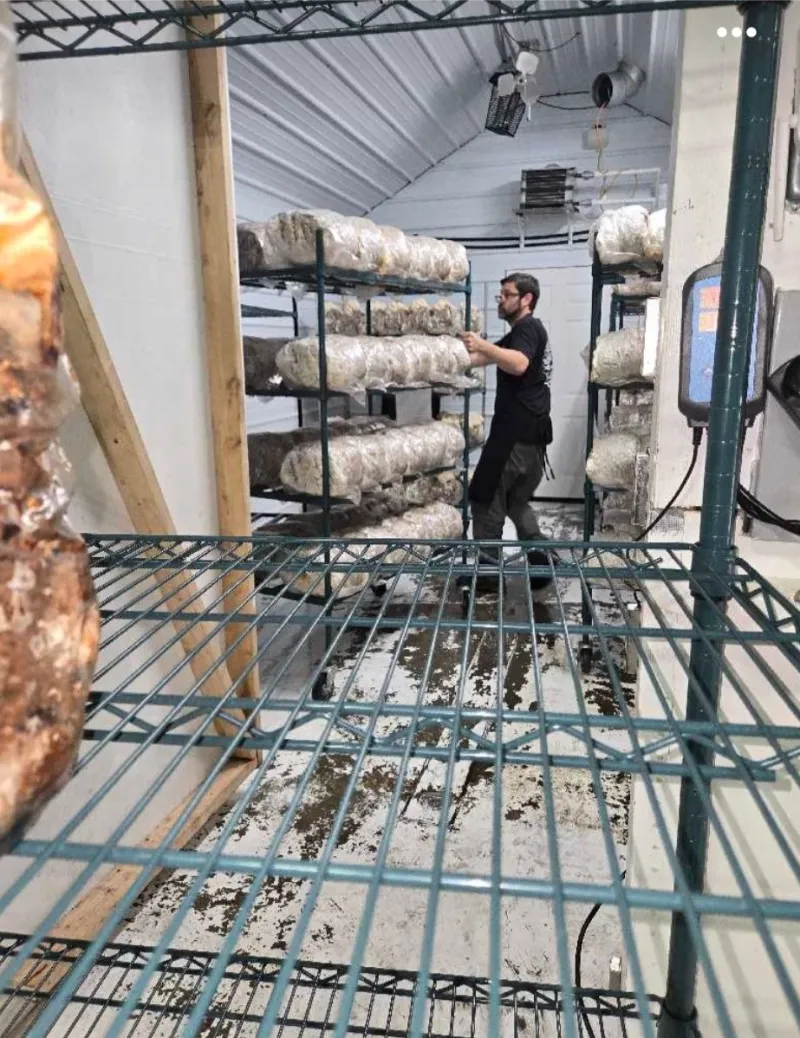
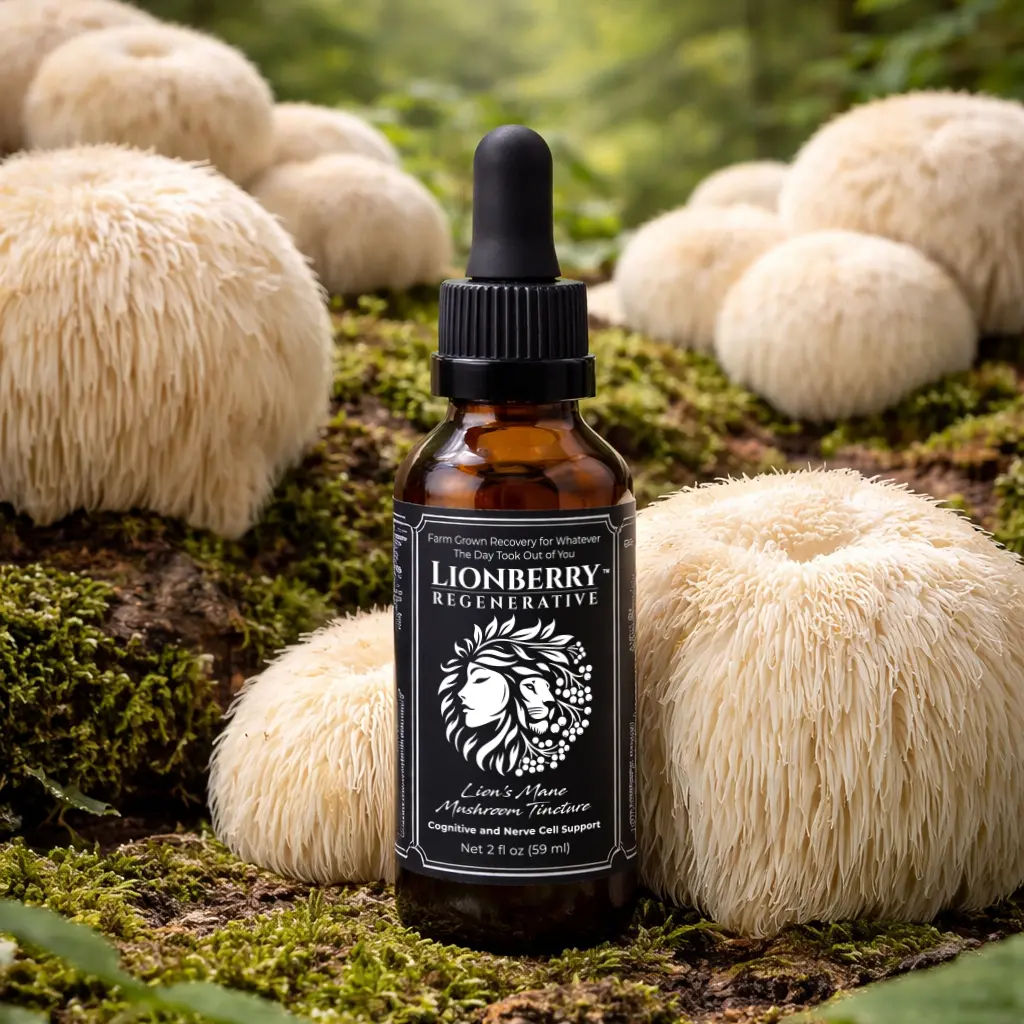
This is Lion’s Mane. It’s a double extract—both alcohol and water—produced in a reactor at Meyers Mushrooms. Meyers is considered an expert in the Midwest on Lion’s Mane and tinctures, and this extraction is very powerful.

It contains both the fruiting body and some mycelium, which provide the beneficial plant compounds we need—the precursors and stimulants for nerve growth factor (NGF) and brain-derived neurotrophic factor (BDNF). These are essentially “miracle grow” for nerve dendrites or branches.

When life events occur—such as depression, stroke, mental illness, or simply aging—our nerve branches and dendrites shrink. In youth, we naturally have more NGF and BDNF, but over time they decline. Research on Lion’s Mane has shown that compounds called hericenones and erinacines stimulate NGF and BDNF, promoting nerve regrowth.

People usually take about half a dropper mixed into coffee, tea, or a smoothie. On its own, the flavor is very strong—like mushroom extract or “mushroom vodka.” But once blended into a drink, the taste disappears.

Question: Is that the same kind of Lion’s Mane found at the farmer’s market?

Yes. Fresh Lion’s Mane is delicious, often compared to seafood, and can be cooked. However, to reach the same phytonutrient levels as the extract, you’d need to eat huge amounts. Extracts provide concentrated benefits for nerve regeneration.

That’s why we include Lion’s Mane in Lionberry—combining it with elderberry for both health and flavor.

Getting Started with Elderberry:

Drinks or Concentrates

If I am new to elderberry, where would you suggest I start with your products?

It depends on your personality. If you like to do things yourself, you might take a teaspoon each day of the more concentrated form. Or, if you’d rather try something ready-made, you can start with a four-pack of the elderberry drink and see how you like it.

Both options taste great—even the concentrated forms. They have a flavor similar to grape and tart cherry, so they’re very pleasant. Either way works.

I often say that food is literally medicine. That’s been highlighted in recent documentaries like Common Ground, and I truly believe it. Food has always been medicine. It’s not some new trend—it’s part of our history. We’ve always eaten with health in mind, and from an evolutionary standpoint, that hasn’t changed.

So, eating what’s healthy for us is the first step—not only toward personal wellness but also toward regenerative agriculture.

Why Take Elderberry?

Antioxidants and Inflammation Support

I hear a lot about elderberry. It sounds like it’s really popular right now, but why should I be taking it?

Elderberry is simply a very good food. On antioxidant scales, depending on which one you look at, elderberry often ranks five to ten times higher than fruits like raspberries or blueberries.

The primary type of antioxidant in elderberry is called an anthocyanin, which is common in purple fruits. Among fruits, elderberry ranks near the very top for anthocyanin content—second only to chokeberry.

These antioxidants are especially beneficial for reducing inflammation in the body. As they break down, they form helpful metabolites, including protocatechuic acid, which also supports health.

When Will I Notice Results from Lion’s Mane?

Will I notice results from Lion’s Mane right away?

I don’t give medical advice—these are foods. But I’ve read a lot of research, and of course I take it myself. Research suggests that men may notice results a little faster than women. Generally, people see benefits somewhere between one and three weeks if they use Lion’s Mane as part of a daily ritual. Even just two milliliters a day can be effective, though you can certainly take more.

I hear from everyone—seniors facing cognitive decline to members of Gen Z dealing with ADHD. Interest in Lion’s Mane is growing rapidly. I believe that within the next four or five years, it will become a common staple in our kitchen cabinets. Just as calcium and vitamin D are added to orange juice and milk, or iodine fortifies salt, Lion’s Mane will be used to fortify drinks—such as Lionberry.

Will Picky Kids Like the Taste of Elderberry?

Question: Is this something my picky kids will like?

Yes—it was made with picky kids in mind (and picky big kids, too). The Concord grape and tart cherry make the elderberry sips taste phenomenal. They’re not bitter or clove-like—although I enjoy those flavors, they’re not always popular with picky eaters.

Instead, the drink tastes like a really natural Pedialyte or Gatorade, with a nice honey, tart cherry, and lemon flavor. It’s very good. You’ll notice undertones of elderflower tea and elderberry, but the majority of the base is elderflower tea.

Lion’s Mane Extract and Nerve Growth Support

What’s in that dropper? It looks really interesting.

This is Lion’s Mane. It’s a double extract—both alcohol and water—produced in a reactor at Meyers Mushrooms. Meyers is one of the leading experts in the Midwest on Lion’s Mane and tinctures, and this extraction is very powerful.

It includes both the fruiting body and some mycelium, which provide the plant compounds we need—the precursors and stimulants for nerve growth factor (NGF) and brain-derived neurotrophic factor (BDNF). These are essentially “miracle grow” for nerve dendrites, or nerve branches.

When life events occur—such as depression, stroke, mental illness, or aging—our nerve branches shrink. When we were younger, we had more NGF and BDNF in our systems. Lion’s Mane has been studied extensively, and robust research shows that it provides compounds that help restore nerve growth.

Building a Local Value Chain:

Kansas State Fair

I’m super excited this year to be at the Kansas State Fair. I’ll have my products there as part of what I call my 24-farm value chain. This connects me with Meyers Mushrooms, Shoney Honey, Elder Farms, and Bueller Organics, who help juice the elderberries. I also work with partners who help with elderberry extracts.

Together, this creates a value chain that recirculates the local dollar. When you spend money with me, I turn around and purchase from local farmers, keeping that multiplier effect going right back into the community. That makes me very excited to be at the Kansas State Fair.

I’ll also be inviting my friends and collaborators from the value chain to be guest speakers at my booth, because everyone involved in helping me make these products deserves to connect with the community too.

Elderberry Products and Low-Sugar Options

I often get asked if these products are good for people on keto, or for those who are working out, weightlifting, or otherwise avoiding sugar.

All of my products—except for the Lion’s Mane tincture, which is simply Lion’s Mane and alcohol—contain honey. We use local raw Shoney honey. So, they’re not calorie-free and they do contain some natural carbohydrates, but there is no added sugar and certainly nothing artificial or processed like cane sugar.

I also offer a product, sourced from a friend, called elderberry extract. It contains no added sugar at all, making it a great option for people who want to use elderberry without the sweetness.

Find Us at Festivals and the Kansas State Fair

We have refreshers available at Lenexa, Gardner, and starting tomorrow at the Farm Coalition. Every weekend we’re at a big event—like a festival—and we’ll also be at the Kansas State Fair.

Come find us, or check out the lionberry.us website to see where we’ll be. Stop by, try a recovery drink, and cool off. It’s really hot out there, and this—along with some water—will help you stay refreshed.

How Much Lionberry Should I Drink?

If I get Lionberry, should I drink the whole bottle or just half?

That’s a fun question—it’s like asking me how much of a sandwich you should eat. You can drink the whole bottle if you’re thirsty and want to enjoy it.
Personally, I sometimes split the bottle, just to be a little more mindful of calories since it does contain honey. But it’s still a food, so it’s really about what works for you.

My husband is a welder, and he chugs these bottles. I also work with a couple of athletes who do the same. There’s absolutely nothing wrong with drinking a whole bottle.

BUSINESS SECRETS WEEKLY

Lionberry 's Weekly Delusion and Re-illusion Update.

LionBerry's Weekly Delusion & Re-Illusion Update

Lion's Mane Mushroom Powder in Your Coffee Isn't Lifting Your Brain Fog.

Welcome to Health Food Washing 101: Where Marketing Is the Science and the Label Is the Proof. If It's on the Label, It Must Be True???

THE BOTTOM LINE — FOR THOSE WHO DON'T READ THE WHOLE THING:

Lion's mane mushroom contains two bioactive compounds — hericenones and erinacines — that tell your brain to repair itself, grow new neurons, and cut through brain fog. Erinacine A is currently the most highly researched compound in the world for Alzheimer's disease, Parkinson's disease, and traumatic brain injury. These compounds are alcohol-soluble. They cannot be released by hot water. Coffee is hot water. This means every lion's mane mushroom powder coffee on the market — regardless of what the bag promises — is delivering zero of these brain compounds to your brain. Zero. The powder passes through you untouched.

The only way to get hericenones and erinacines out of the mushroom and into your body is a dual extraction: alcohol AND water, from the fruiting body of the mushroom. That's what LionBerry uses. That's the difference between a product that performs and a product that just looks like it should.

Dual extract = the actual brain compounds, bioavailable, crossing the blood-brain barrier, reaching your brain.

And here's the part nobody mentions: adding a liquid extract to your coffee is not harder than stirring in a powder. It is not a chore. It is not a complicated ritual. It is a dropper in a cup. There is no reason to choose powder over extract. None. The extract does what the powder only pretends to do, and it takes exactly the same amount of effort to use.

Buy whatever coffee you love. Put LionBerry in it instead.

There is a product sitting in your grocery store, your local market, and your favorite wellness shop. It comes in a beautiful bag. It says "clean label." It says "no added sugars." It says "gluten friendly." It might say "adaptogenic." It almost certainly says "lion's mane mushroom" in large letters, because lion's mane is having a moment, and moments sell product.

Ryze. Four Sigmatic. Every white-label mushroom powder coffee that appeared overnight when the trend hit.

What none of them say — anywhere on that bag, in that Instagram post, or in that influencer's sixty-second testimonial — is this:

The lion's mane in here is dried mushroom powder. It cannot reach your brain. It will not lift your brain fog. The focus you feel is caffeine. It was always just the caffeine.

That part didn't make the label.

This is health food washing. The wellness industry's version of greenwashing, where the language of real clinical function gets borrowed by products that cannot perform that function. Slap enough clean-sounding words on a package and the product inherits the credibility of the real thing without doing the work of the real thing. "Focus." "Clarity." "Neurogenesis." "Lift the brain fog." All words that live in the same neighborhood as lion's mane research. None of them accurate when the lion's mane in question is dried powder dissolved in hot water.

It's not lying, exactly. It's just letting you believe something that isn't true and charging you a premium for the privilege.

The lion's mane conversation got hijacked by powder.

And lion's mane is not the first casualty of this. Elderberry has the same problem. People process it into a syrup so aggressively overcooked that the anthocyanins — the actual anti-inflammatory compounds that make elderberry worth anything — get burned off entirely in the heat. Then people try it, feel nothing, and elderberry gets a reputation problem it didn't earn. The plant isn't the failure. The processing is the failure. The label never mentions the processing. The category takes the hit.

Lion's mane is heading down the same road.

Here's what the bag won't tell you, but the science will.

1. WHAT IS ACTUALLY IN LION'S MANE MUSHROOM?

Lion's mane (Hericium erinaceus) contains two classes of bioactive terpenes: HERICENONES and ERINACINES. Both trigger production of NGF (Nerve Growth Factor) and BDNF (Brain-Derived Neurotrophic Factor) — the chemical signals that tell your brain to repair, regrow, and rebuild.

These are the compounds behind focus, clarity, neurogenesis, and actually cutting through brain fog. Not vibes. Not marketing. Chemistry.

Hericenones are aromatic terpenes extracted from the fruiting body of the mushroom. They stimulate NGF biosynthesis directly in brain cells — sending the signal for neurons to repair, regenerate, and reconnect. They are low molecular weight compounds, which means they cross the blood-brain barrier. They reach your brain. Not just your bloodstream. Your actual brain.

Hericenones are the brain repair signal. Most supplements never make it past your gut. Hericenones do.

Erinacines are diterpenoids from the mycelium. They also stimulate NGF synthesis. Erinacine A is the single most researched compound in the world right now for Alzheimer's disease, Parkinson's disease, and traumatic brain injury. Also low molecular weight. Also crosses the blood-brain barrier.

Both are in this bottle. Both are doing work.

Neither one does anything for your brain unless they have been properly extracted. That is the entire problem. That is the only problem. And that is exactly where every lion's mane mushroom powder coffee on the market is failing you.

2. THE BRAIN FOG IS STILL THERE. IT'S JUST MORE EXPENSIVE NOW.

Here's what actually matters, and what the label will never tell you:

Hericenones and erinacines are alcohol-soluble terpenes.

Not water-soluble.

Alcohol-soluble.

Every popular lion's mane mushroom powder coffee on the market mixes dried powdered lion's mane into coffee — which is hot water. Hot water cannot extract alcohol-soluble compounds. This is not an opinion. This is basic chemistry.

Hericenones and erinacines are alcohol-soluble terpenes. Coffee is hot water. Hot water cannot touch them.

Those terpenes stay locked inside the chitin cell wall of the dried mushroom powder. Chitin is the same material as crab shells. Your gut does not have the enzymes to break it down. It was not built for it.

The lion's mane mushroom powder passes through you completely intact. Completely inert. Your brain never saw it.

So the powder dissolves into your cup, looks like something is happening, and exits your body exactly the same way it came in. Untouched. Unabsorbed. Unbothered.

Expensive and unbothered.

What you DO feel from lion's mane mushroom powder coffee? That's caffeine. Caffeine genuinely works — caffeine feels like focus, your brain interprets it as clarity, and for a few weeks, maybe a few months, you think the lion's mane is doing something. The brain associates the ritual with the result. The placebo is real enough to feel like progress.

It's not the lion's mane. It was never the lion's mane. That's just Tuesday morning with coffee.

Then the caffeine stops being novel. The placebo wears off. You're right back to losing your keys and walking into rooms and forgetting why you went in there.

And now lion's mane has a reputation problem it didn't earn. The powder failed you. The extract never got a chance. The whole category takes the hit — and every product with "lion's mane" on the label, including the ones that are actually extracted properly and actually work, gets written off as hype.

That's the damage. Not just to LionBerry. To the entire conversation about what lion's mane can actually do.

⚠️ LION'S MANE MUSHROOM POWDER IN YOUR COFFEE = YOU ARE PAYING FOR PLACEBO ⚠️

3. WHAT LION'S MANE MUSHROOM POWDER GIVES YOU — AND WHAT IT ABSOLUTELY DOES NOT

What you get ZERO of from dried lion's mane mushroom powder:

✗ Hericenones — locked in chitin, not bioavailable, not reaching your brain

✗ Erinacines — same problem, same chitin wall, same result

✗ NGF induction — not happening

✗ BDNF induction — not happening

✗ Neurogenesis — no

✗ Dendritic regrowth — no

✗ Myelin sheath support — no

✗ Focus — not from the lion's mane

✗ Clarity — not from the lion's mane

✗ Cutting through brain fog — absolutely not

If you bought lion's mane mushroom powder coffee for focus, clarity, and lifting brain fog — you got the immune product with brain health branding. That is not science. That is health food washing. Great product. Wrong label. Wrong promises.

Powder does contain beta-glucans, which support immune function, gut health, blood sugar, and cholesterol. Those are real benefits. But nobody is buying mushroom coffee for their cholesterol. And there is no reason — not one — to choose a powder that cannot deliver the brain benefits over a liquid extract that can. A dropper in your coffee takes exactly the same effort as stirring in a powder. The extract does what the powder cannot. This is not a hard choice.

4. BUY WHATEVER COFFEE YOU LOVE. PUT THIS IN IT INSTEAD.

For the actual brain benefits — neurogenesis, dendritic regrowth, myelin sheath protection, NGF and BDNF induction, real focus, real clarity, actual brain fog obliteration — you need a dual extract: alcohol AND water, from the fruiting body of the mushroom.

The alcohol pulls the hericenones and erinacines out of the chitin cell wall and into a bioavailable form. The water captures the beta-glucans. Your brain gets what it was promised. Your immune system gets the bonus.

The alcohol pulls the brain compounds out. The water gets the immune compounds. You need both. That's what a dual extract is.

Both hericenones and erinacines are low molecular weight compounds. They cross the blood-brain barrier. They actually reach your brain — not just your bloodstream. Your brain.

Most supplements never get past your gut. These do.

LionBerry uses a dual extract — alcohol and water — from the fruiting body of the mushroom, because that is the only way to get hericenones and erinacines out of the chitin wall and into a form your body can absorb and your brain can use. It costs more to do it this way. It takes longer. It cannot be scaled by cutting corners.

We don't cut corners. Not because it's easy. Because the lion's mane in this bottle is supposed to do what lion's mane is supposed to do.

LION'S MANE MUSHROOM POWDER COFFEE ≠ NGF/BDNF induction

LION'S MANE MUSHROOM POWDER COFFEE ≠ neurogenesis

LION'S MANE MUSHROOM POWDER COFFEE ≠ myelin sheath protection

LION'S MANE MUSHROOM POWDER COFFEE ≠ dendritic regrowth

LION'S MANE MUSHROOM POWDER COFFEE ≠ lifting the brain fog

It does taste good though. We'll give it that.

5. WHAT A DUAL EXTRACT ACTUALLY DELIVERS

✓ Hericenones → NGF/BDNF stimulation → brain repair and rebuild signal activated

✓ Erinacines → NGF synthesis → neuroregeneration and neuroprotection

✓ Blood-brain barrier penetration — low molecular weight, actually reaches your brain

✓ Neurogenesis — growth of new neurons

✓ Dendritic regrowth — rebuilding the connections between neurons

✓ Myelin sheath support → nerve conduction, reaction time, sustained focus

✓ Actual brain fog relief — the real kind, not the caffeine kind

✓ Beta-glucans → immune and gut benefits included

✓ Bioavailability guaranteed — extraction breaks the chitin wall so your body can actually absorb it

Real extraction.

Real bioavailability.

Real compounds reaching your actual brain.

Zero powdered fantasy.

Brain repair. Nerve growth. Immune support. Gut health. One bottle. Properly extracted so your body can actually use it. Revolutionary concept, we know.

Buy whatever coffee you love.

Put this in it instead.

RESEARCH CITATIONS

Because we didn't make this up.

[1] Ma et al. (2010). Hericenones and erinacines: NGF biosynthesis stimulators. Mycology — DOI: 10.1080/21501201003735556

[2] Kawagishi et al. (1991). Hericenones C, D and E, NGF synthesis stimulators. Tetrahedron Letters

[3] Friedman M. (2015). Chemistry, Nutrition, and Health-Promoting Properties of Hericium erinaceus. Journal of Agricultural and Food Chemistry — DOI: 10.1021/acs.jafc.5b02914

[4] Ratto et al. (2022). Hericerin derivatives and pan-neurotrophic pathway activation in hippocampal neurons. Journal of Neurochemistry — DOI: 10.1111/jnc.15767

[5] PMC Narrative Review (2024). Lion's Mane: A Neuroprotective Fungus. PMC — pmc.ncbi.nlm.nih.gov/articles/PMC12030463

[6] Phan et al. (2014). Hericenones and NGF-mediated neurite outgrowth via MEK/ERK and PI3K-Akt signaling. Food & Function — DOI: 10.1039/c4fo00031e

[7] Restorative Medicine Monograph — Lion's Mane comprehensive review. Restorative Medicine — restorativemedicine.org/library/monographs/lions-mane

LionBerry Regenerative

Facebook & Instagram: @lionberry

Business Secrets Weekly drops every Sunday at www.lionberry.us