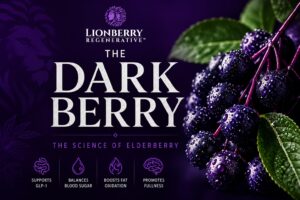
The Dark Berry

BS Weekly #13

The color is not a coincidence.

The dark, almost-black purple of elderberry is not just a visual marker of ripeness. It is a signal of bioactive density. The anthocyanin molecule responsible for that color… cyanidin-3-glucoside, or C3G… is pH-responsive, meaning its molecular structure physically shifts depending on the acidity of its environment [12]. In acidic conditions it appears red. At neutral pH it goes purple. In alkaline conditions it shifts toward blue and eventually breaks down entirely [12]. This is not a cosmetic property. It is a window into the molecule’s chemistry. The same pH sensitivity that makes the color shift is what makes C3G reactive inside your digestive system… and reactive in exactly the right way, because your stomach is acidic, and acid stabilizes the molecule right when it needs to survive [14].

What C3G Actually Is

Cyanidin-3-O-glucoside… abbreviated C3G… is an anthocyanin. Anthocyanins are water-soluble plant pigments in the flavonoid family responsible for the red, purple, and blue colors of dark berries. Elderberry is one of the densest sources of anthocyanins in the known food supply.

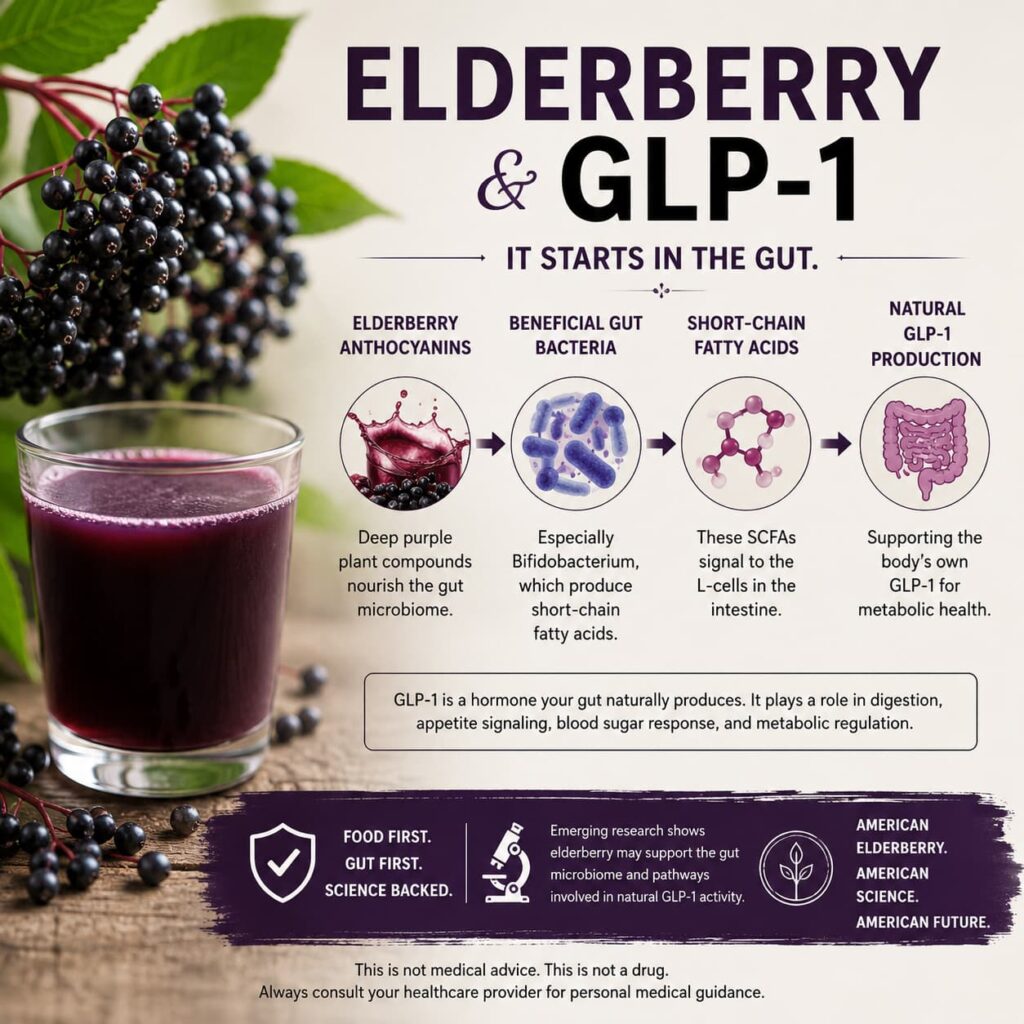
C3G is specifically a cyanidin molecule with a glucose molecule attached at the 3-position of its carbon ring. That structure matters for how it moves through your body and how it interacts with your gut. C3G is not a GLP-1 agonist. It does not bind to the GLP-1 receptor the way tirzepatide, Mounjaro, or Zepbound do. What it does is different and arguably more interesting… it stimulates your intestinal L cells to make more of your own GLP-1 from the inside [1]. The drug mimics the hormone from the outside. Elderberry… because it is food, because it is a berry, because it moves through your gut the way food does… triggers your body to produce the hormone itself. That is not a drug mechanism. That is food doing what food has always done. We just finally have the tools to watch it happen.

Research published in npj Science of Food confirmed that C3G treatment increased GLP-1 secretion in intestinal L cells via the PPARβ/δ… β-catenin… TCF-4 signaling pathway, which enhances the transcription of the proglucagon precursor that L cells use to synthesize GLP-1 [1]. C3G stimulates GLP-1 secretion from intestinal L cells via this pathway, thereby enhancing insulin secretion and improving glycemic control [1].

What the L Cell Is and What GLP-1 Does to Your Body

The L cell is a specialized enteroendocrine cell lining the wall of the intestine, concentrated in the ileum and colon. Its job is to sense what is coming through the gut… nutrients, fiber, certain plant compounds including C3G… and release hormonal signals in response [2]. GLP-1 is produced in intestinal L cells through posttranslational processing of the proglucagon gene and is released from the gut in response to nutrient ingestion [3].

Once C3G triggers the L cell and GLP-1 is secreted into circulation, it does multiple things simultaneously throughout the body that are directly relevant to blood sugar, metabolic health, and fat metabolism:

It tells the pancreas to release insulin in a glucose-dependent manner… meaning only when blood sugar is actually elevated, which is why it does not cause the hypoglycemic crashes that some diabetes medications do [3].

It blocks glucagon… the hormone that raises blood sugar… from being secreted by the pancreas, which further stabilizes blood glucose levels after meals [3].

It slows gastric emptying… food moves more slowly from the stomach into the small intestine… which flattens the blood sugar curve after eating, reduces postprandial glucose spikes, and extends the feeling of satiety [4].

It acts on GLP-1 receptors in the brainstem and hypothalamus to promote fullness and reduce appetite… GLP-1 has been shown to promote satiety and reduce both food and water intake [4].

It directly supports fat oxidation… the WSU clinical trial documented a 27% increase in fat oxidation at rest and during exercise in participants consuming elderberry juice for one week, consistent with the metabolic effects of increased endogenous GLP-1 activity [17].

The half-life of endogenous GLP-1 in circulation is approximately two minutes before it is degraded by the enzyme DPP-4 [4]. This is why pharmaceutical GLP-1 agonists are engineered to be DPP-4 resistant… they stay in the system far longer than your body’s own version. Elderberry does not extend the half-life. What it does is increase the rate of production… more signal from more L cells, more often, through food.

Is C3G Found More in American Elderberry

Both American elderberry (Sambucus canadensis) and European elderberry (Sambucus nigra) contain C3G. A USDA study comparing both species grown side by side found that both produce cyanidin-based anthocyanins as their dominant pigments, but with meaningfully different profiles [6]. In European elderberry, C3G makes up roughly 40 to 50% of total anthocyanins. In American elderberry, the dominant anthocyanins are acylated forms… meaning the cyanidin molecule has an additional organic acid group attached… making up approximately 65 to 70% of total anthocyanins, with C3G present but not dominant [15].

What matters for the L cell is not which species has the highest percentage of C3G on paper. What matters is how much active cyanidin-based compound arrives at the L cell intact after surviving processing, storage, and the journey through your gut. Acylated anthocyanins from American elderberry were more stable than cyanidin 3-sambubioside from European elderberry, with acylation improving both heat and light stability [6]. American elderberry’s acylated forms survive the journey better… and they break down in the gut into the same cyanidin-based compounds that stimulate L cell GLP-1 production [1].

Total anthocyanin content in American elderberry cultivars ranges from 85 to 385 mg per 100 grams depending on cultivar and growing conditions [7]. That nearly fourfold range is not a minor variation. It is the difference between a berry that moves the needle on L cell stimulation and one that does not. The Wyldewood and Bob Gordon cultivars are among the highest-anthocyanin American elderberry cultivars documented in the literature [16].

How C3G Gets to the L Cell

C3G faces a gauntlet between the berry and the L cell. Understanding that gauntlet explains why processing matters so much.

The stomach is actually C3G’s friend. The pH value of the stomach environment is generally 0.9 to 1.5. Anthocyanins are relatively stable at pH 2 or below and can be rapidly absorbed in the stomach, appearing in plasma within 30 minutes after ingestion. The acidity that protects the molecule in a well-processed elderberry product continues protecting it in the stomach. Some C3G absorbs directly through the stomach wall into circulation [9].

The challenge comes in the small intestine. Anthocyanins are destabilized by the neutral to slightly alkaline pH of the small intestine. As C3G moves from the acidic stomach into the small intestine the pH rises, the molecule becomes less stable, and some degrades. What survives is absorbed via the SGLT1 and GLUT2 glucose transporters in the intestinal wall [9]. Exposure to intestinal conditions leads to a decrease in C3G bioavailability by 40 to 50% overall [10].

What does not get absorbed intact continues to the colon where Bifidobacterium metabolizes it. Those metabolites stimulate L cells to produce more GLP-1 through the SCFA pathway… a second route to the same destination [11]. Two pathways. One berry. Both landing on the L cell.

How to Process Elderberry to Preserve C3G for the L Cell

This is where most of the commercial elderberry industry gets it wrong and most consumers have no way of knowing.

C3G is destroyed by heat, oxidation, light, and time. Heating elderberry at temperatures ranging from 212 to 302°F causes significant structural changes in anthocyanins, degrading both the bioactive compounds and their antioxidant activity [8]. Extended heat processing does not sterilize the medicine… it eliminates it.

Elderberry, with its softer peel structure, is more prone to anthocyanin degradation by heat than other berry fruits [8]. A blueberry or a grape can withstand certain processing conditions that will simply destroy elderberry anthocyanins.

What preserves C3G so it can actually reach the L cell:

  • Fresh pressing or cold pressing to juice immediately after harvest
  • Dropping the pH of the finished product acidifies the environment and stabilizes the C3G molecule structurally… the color shift from purple toward red confirms it is working [12]
  • Flash pasteurization at the lowest temperature and shortest time that achieves food safety requirements rather than extended boiling
  • Cold storage to minimize oxidative degradation
  • Processing as close to harvest as possible… anthocyanins degrade in the berry after picking even without heat

The color of the finished product tells you most of what you need to know. A deeply purple, almost black elderberry juice has retained its anthocyanins. A pale, brownish, or dull product has not. The color is not the brand. The color is the medicine. Trust the color.

METABOLIC RECOVERY

It starts with the dark berry.

Everything else follows from here.

Bevin Brooks

Business Secrets Weekly drops every Sunday at www.lionberry.us
References

[1] Xu, Y. et al. (2025). Cyanidin-3-O-glucoside enhances GLP-1 secretion via PPARβ/δ-β-catenin-TCF-4 pathway in type 2 diabetes mellitus. npj Science of Food, 9, 47. DOI: 10.1038/s41538-025-00445-4

[2] Habib, A.M. et al. (2021). What is an L-cell and how do we study the secretory mechanisms of the L-cell? Frontiers in Endocrinology, 12, 624009. DOI: 10.3389/fendo.2021.624009

[3] Drucker, D.J. (2002). The multiple actions of GLP-1 on the process of glucose-stimulated insulin secretion. Diabetes, 51(S3), S434–S442. DOI: 10.2337/diabetes.51.2007.S434

[4] Holst, J.J. (2007). The physiology of glucagon-like peptide 1. Physiological Reviews, 87(4), 1409–1439. DOI: 10.1152/physrev.00034.2006

[5] Drucker, D.J. (2006). The biology of incretin hormones. Cell Metabolism, 3(3), 153–165. DOI: 10.1016/j.cmet.2006.01.004

[6] Lee, J. & Finn, C.E. (2007). Anthocyanins and other polyphenolics in American elderberry (Sambucus canadensis) and European elderberry (Sambucus nigra) cultivars. Journal of the Science of Food and Agriculture, 87(14), 2665–2675. DOI: 10.1002/jsfa.3029

[7] Finn, C.E. et al. (2008). Fruit composition of elderberry (Sambucus spp.) genotypes grown in Oregon and Missouri, USA. HortScience, 43(5), 1501–1507. DOI: 10.21273/HORTSCI.43.5.1501

[8] Oancea, A.M. et al. (2018). The kinetics of thermal degradation of polyphenolic compounds from elderberry extract. Journal of Food Science and Technology, 55(2). DOI: 10.1177/1082013218756139

[9] Zou, T.B. et al. (2014). The role of sodium-dependent glucose transporter 1 and glucose transporter 2 in the absorption of cyanidin-3-O-β-glucoside. Nutrients, 6(10), 4165–4177. DOI: 10.3390/nu6104165

[10] Xu, Y. et al. (2023). Cyanidin-3-O-glucoside as a nutrigenomic factor in type 2 diabetes and its prominent impact on health. International Journal of Molecular Sciences, 24(10), 8875. DOI: 10.3390/ijms24108875

[11] Tolhurst, G. et al. (2012). Short-chain fatty acids stimulate glucagon-like peptide-1 secretion via the G-protein-coupled receptor FFAR2. Diabetes, 61(2), 364–371. DOI: 10.2337/db11-1019

[12] Khoo, H.E. et al. (2017). Anthocyanidins and anthocyanins: colored pigments as food, pharmaceutical ingredients, and the potential health benefits. Food & Nutrition Research, 61(1), 1361779. DOI: 10.1080/16546628.2017.1361779

[13] Chen, Z. et al. (2023). Preparation of an elderberry anthocyanin film and fresh-keeping effect of its application on fresh shrimps. PLOS ONE, 18(11), e0290650. DOI: 10.1371/journal.pone.0290650

[14] Liang, M. et al. (2023). Factors affecting the stability of anthocyanins and strategies for improving their stability. Food Chemistry: X, 20, 100867. DOI: 10.1016/j.fochx.2023.100867

[15] Kuhnau, J. (1976). The flavonoids: a class of semi-essential food components. World Review of Nutrition and Dietetics, 24, 117–191.

[16] Thomas, A.L. et al. (2015). Comparison of fruit characteristics among diverse elderberry genotypes grown in Missouri and Oregon. Journal of the American Pomological Society, 69(1), 2–14.

[17] Solverson, P. et al. (2024). A one-week elderberry juice intervention augments the fecal microbiota and suggests improvement in glucose tolerance and fat oxidation in a randomized controlled trial. Nutrients, 16(20), 3555. DOI: 10.3390/nu16203555

Facebook
X
LinkedIn

BUSINESS SECRETS WEEKLY

Lionberry 's Weekly Delusion and Re-illusion Update.

LionBerry’s Weekly Delusion & Re-Illusion Update

Lion’s Mane Mushroom Powder in Your Coffee Isn’t Lifting Your Brain Fog.

Welcome to Health Food Washing 101: Where Marketing Is the Science and the Label Is the Proof. If It’s on the Label, It Must Be True???

THE BOTTOM LINE — FOR THOSE WHO DON’T READ THE WHOLE THING:

Lion’s mane mushroom contains two bioactive compounds — hericenones and erinacines — that tell your brain to repair itself, grow new neurons, and cut through brain fog. Erinacine A is currently the most highly researched compound in the world for Alzheimer’s disease, Parkinson’s disease, and traumatic brain injury. These compounds are alcohol-soluble. They cannot be released by hot water. Coffee is hot water. This means every lion’s mane mushroom powder coffee on the market — regardless of what the bag promises — is delivering zero of these brain compounds to your brain. Zero. The powder passes through you untouched.

The only way to get hericenones and erinacines out of the mushroom and into your body is a dual extraction: alcohol AND water, from the fruiting body of the mushroom. That’s what LionBerry uses. That’s the difference between a product that performs and a product that just looks like it should.

Dual extract = the actual brain compounds, bioavailable, crossing the blood-brain barrier, reaching your brain.

And here’s the part nobody mentions: adding a liquid extract to your coffee is not harder than stirring in a powder. It is not a chore. It is not a complicated ritual. It is a dropper in a cup. There is no reason to choose powder over extract. None. The extract does what the powder only pretends to do, and it takes exactly the same amount of effort to use.

Buy whatever coffee you love. Put LionBerry in it instead.

There is a product sitting in your grocery store, your local market, and your favorite wellness shop. It comes in a beautiful bag. It says “clean label.” It says “no added sugars.” It says “gluten friendly.” It might say “adaptogenic.” It almost certainly says “lion’s mane mushroom” in large letters, because lion’s mane is having a moment, and moments sell product.

Ryze. Four Sigmatic. Every white-label mushroom powder coffee that appeared overnight when the trend hit.

What none of them say — anywhere on that bag, in that Instagram post, or in that influencer’s sixty-second testimonial — is this:

The lion’s mane in here is dried mushroom powder. It cannot reach your brain. It will not lift your brain fog. The focus you feel is caffeine. It was always just the caffeine.

That part didn’t make the label.

This is health food washing. The wellness industry’s version of greenwashing, where the language of real clinical function gets borrowed by products that cannot perform that function. Slap enough clean-sounding words on a package and the product inherits the credibility of the real thing without doing the work of the real thing. “Focus.” “Clarity.” “Neurogenesis.” “Lift the brain fog.” All words that live in the same neighborhood as lion’s mane research. None of them accurate when the lion’s mane in question is dried powder dissolved in hot water.

It’s not lying, exactly. It’s just letting you believe something that isn’t true and charging you a premium for the privilege.

The lion’s mane conversation got hijacked by powder.

And lion’s mane is not the first casualty of this. Elderberry has the same problem. People process it into a syrup so aggressively overcooked that the anthocyanins — the actual anti-inflammatory compounds that make elderberry worth anything — get burned off entirely in the heat. Then people try it, feel nothing, and elderberry gets a reputation problem it didn’t earn. The plant isn’t the failure. The processing is the failure. The label never mentions the processing. The category takes the hit.

Lion’s mane is heading down the same road.

Here’s what the bag won’t tell you, but the science will.

1. WHAT IS ACTUALLY IN LION’S MANE MUSHROOM?

Lion’s mane (Hericium erinaceus) contains two classes of bioactive terpenes: HERICENONES and ERINACINES. Both trigger production of NGF (Nerve Growth Factor) and BDNF (Brain-Derived Neurotrophic Factor) — the chemical signals that tell your brain to repair, regrow, and rebuild.

These are the compounds behind focus, clarity, neurogenesis, and actually cutting through brain fog. Not vibes. Not marketing. Chemistry.

Hericenones are aromatic terpenes extracted from the fruiting body of the mushroom. They stimulate NGF biosynthesis directly in brain cells — sending the signal for neurons to repair, regenerate, and reconnect. They are low molecular weight compounds, which means they cross the blood-brain barrier. They reach your brain. Not just your bloodstream. Your actual brain.

Hericenones are the brain repair signal. Most supplements never make it past your gut. Hericenones do.

Erinacines are diterpenoids from the mycelium. They also stimulate NGF synthesis. Erinacine A is the single most researched compound in the world right now for Alzheimer’s disease, Parkinson’s disease, and traumatic brain injury. Also low molecular weight. Also crosses the blood-brain barrier.

Both are in this bottle. Both are doing work.

Neither one does anything for your brain unless they have been properly extracted. That is the entire problem. That is the only problem. And that is exactly where every lion’s mane mushroom powder coffee on the market is failing you.

2. THE BRAIN FOG IS STILL THERE. IT’S JUST MORE EXPENSIVE NOW.

Here’s what actually matters, and what the label will never tell you:

Hericenones and erinacines are alcohol-soluble terpenes.

Not water-soluble.

Alcohol-soluble.

Every popular lion’s mane mushroom powder coffee on the market mixes dried powdered lion’s mane into coffee — which is hot water. Hot water cannot extract alcohol-soluble compounds. This is not an opinion. This is basic chemistry.

Hericenones and erinacines are alcohol-soluble terpenes. Coffee is hot water. Hot water cannot touch them.

Those terpenes stay locked inside the chitin cell wall of the dried mushroom powder. Chitin is the same material as crab shells. Your gut does not have the enzymes to break it down. It was not built for it.

The lion’s mane mushroom powder passes through you completely intact. Completely inert. Your brain never saw it.

So the powder dissolves into your cup, looks like something is happening, and exits your body exactly the same way it came in. Untouched. Unabsorbed. Unbothered.

Expensive and unbothered.

What you DO feel from lion’s mane mushroom powder coffee? That’s caffeine. Caffeine genuinely works — caffeine feels like focus, your brain interprets it as clarity, and for a few weeks, maybe a few months, you think the lion’s mane is doing something. The brain associates the ritual with the result. The placebo is real enough to feel like progress.

It’s not the lion’s mane. It was never the lion’s mane. That’s just Tuesday morning with coffee.

Then the caffeine stops being novel. The placebo wears off. You’re right back to losing your keys and walking into rooms and forgetting why you went in there.

And now lion’s mane has a reputation problem it didn’t earn. The powder failed you. The extract never got a chance. The whole category takes the hit — and every product with “lion’s mane” on the label, including the ones that are actually extracted properly and actually work, gets written off as hype.

That’s the damage. Not just to LionBerry. To the entire conversation about what lion’s mane can actually do.

⚠️ LION’S MANE MUSHROOM POWDER IN YOUR COFFEE = YOU ARE PAYING FOR PLACEBO ⚠️

3. WHAT LION’S MANE MUSHROOM POWDER GIVES YOU — AND WHAT IT ABSOLUTELY DOES NOT

What you get ZERO of from dried lion’s mane mushroom powder:

✗ Hericenones — locked in chitin, not bioavailable, not reaching your brain

✗ Erinacines — same problem, same chitin wall, same result

✗ NGF induction — not happening

✗ BDNF induction — not happening

✗ Neurogenesis — no

✗ Dendritic regrowth — no

✗ Myelin sheath support — no

✗ Focus — not from the lion’s mane

✗ Clarity — not from the lion’s mane

✗ Cutting through brain fog — absolutely not

If you bought lion’s mane mushroom powder coffee for focus, clarity, and lifting brain fog — you got the immune product with brain health branding. That is not science. That is health food washing. Great product. Wrong label. Wrong promises.

Powder does contain beta-glucans, which support immune function, gut health, blood sugar, and cholesterol. Those are real benefits. But nobody is buying mushroom coffee for their cholesterol. And there is no reason — not one — to choose a powder that cannot deliver the brain benefits over a liquid extract that can. A dropper in your coffee takes exactly the same effort as stirring in a powder. The extract does what the powder cannot. This is not a hard choice.

4. BUY WHATEVER COFFEE YOU LOVE. PUT THIS IN IT INSTEAD.

For the actual brain benefits — neurogenesis, dendritic regrowth, myelin sheath protection, NGF and BDNF induction, real focus, real clarity, actual brain fog obliteration — you need a dual extract: alcohol AND water, from the fruiting body of the mushroom.

The alcohol pulls the hericenones and erinacines out of the chitin cell wall and into a bioavailable form. The water captures the beta-glucans. Your brain gets what it was promised. Your immune system gets the bonus.

The alcohol pulls the brain compounds out. The water gets the immune compounds. You need both. That’s what a dual extract is.

Both hericenones and erinacines are low molecular weight compounds. They cross the blood-brain barrier. They actually reach your brain — not just your bloodstream. Your brain.

Most supplements never get past your gut. These do.

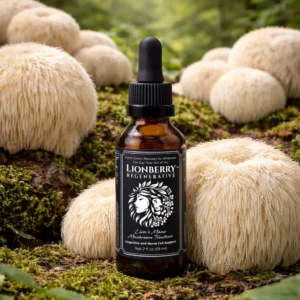
LionBerry uses a dual extract — alcohol and water — from the fruiting body of the mushroom, because that is the only way to get hericenones and erinacines out of the chitin wall and into a form your body can absorb and your brain can use. It costs more to do it this way. It takes longer. It cannot be scaled by cutting corners.

We don’t cut corners. Not because it’s easy. Because the lion’s mane in this bottle is supposed to do what lion’s mane is supposed to do.

LION’S MANE MUSHROOM POWDER COFFEE ≠ NGF/BDNF induction

LION’S MANE MUSHROOM POWDER COFFEE ≠ neurogenesis

LION’S MANE MUSHROOM POWDER COFFEE ≠ myelin sheath protection

LION’S MANE MUSHROOM POWDER COFFEE ≠ dendritic regrowth

LION’S MANE MUSHROOM POWDER COFFEE ≠ lifting the brain fog

It does taste good though. We’ll give it that.

5. WHAT A DUAL EXTRACT ACTUALLY DELIVERS

✓ Hericenones → NGF/BDNF stimulation → brain repair and rebuild signal activated

✓ Erinacines → NGF synthesis → neuroregeneration and neuroprotection

✓ Blood-brain barrier penetration — low molecular weight, actually reaches your brain

✓ Neurogenesis — growth of new neurons

✓ Dendritic regrowth — rebuilding the connections between neurons

✓ Myelin sheath support → nerve conduction, reaction time, sustained focus

✓ Actual brain fog relief — the real kind, not the caffeine kind

✓ Beta-glucans → immune and gut benefits included

✓ Bioavailability guaranteed — extraction breaks the chitin wall so your body can actually absorb it

Real extraction.

Real bioavailability.

Real compounds reaching your actual brain.

Zero powdered fantasy.

Brain repair. Nerve growth. Immune support. Gut health. One bottle. Properly extracted so your body can actually use it. Revolutionary concept, we know.

Buy whatever coffee you love.

Put this in it instead.

RESEARCH CITATIONS

Because we didn’t make this up.

[1] Ma et al. (2010). Hericenones and erinacines: NGF biosynthesis stimulators. Mycology — DOI: 10.1080/21501201003735556

[2] Kawagishi et al. (1991). Hericenones C, D and E, NGF synthesis stimulators. Tetrahedron Letters

[3] Friedman M. (2015). Chemistry, Nutrition, and Health-Promoting Properties of Hericium erinaceus. Journal of Agricultural and Food Chemistry — DOI: 10.1021/acs.jafc.5b02914

[4] Ratto et al. (2022). Hericerin derivatives and pan-neurotrophic pathway activation in hippocampal neurons. Journal of Neurochemistry — DOI: 10.1111/jnc.15767

[5] PMC Narrative Review (2024). Lion’s Mane: A Neuroprotective Fungus. PMC — pmc.ncbi.nlm.nih.gov/articles/PMC12030463

[6] Phan et al. (2014). Hericenones and NGF-mediated neurite outgrowth via MEK/ERK and PI3K-Akt signaling. Food & Function — DOI: 10.1039/c4fo00031e

[7] Restorative Medicine Monograph — Lion’s Mane comprehensive review. Restorative Medicine — restorativemedicine.org/library/monographs/lions-mane

LionBerry Regenerative

Facebook & Instagram: @lionberry

Business Secrets Weekly drops every Sunday at www.lionberry.us