

BS Weekly #13
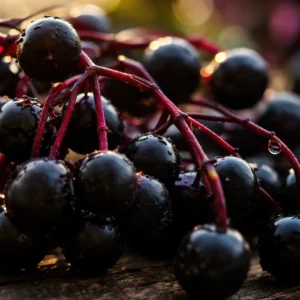
The color is not a coincidence.
The dark, almost-black purple of elderberry is not just a visual marker of ripeness. It is a signal of bioactive density. The anthocyanin molecule responsible for that color… cyanidin-3-glucoside, or C3G… is pH-responsive, meaning its molecular structure physically shifts depending on the acidity of its environment [12]. In acidic conditions it appears red. At neutral pH it goes purple. In alkaline conditions it shifts toward blue and eventually breaks down entirely [12]. This is not a cosmetic property. It is a window into the molecule’s chemistry. The same pH sensitivity that makes the color shift is what makes C3G reactive inside your digestive system… and reactive in exactly the right way, because your stomach is acidic, and acid stabilizes the molecule right when it needs to survive [14].
What C3G Actually Is
Cyanidin-3-O-glucoside… abbreviated C3G… is an anthocyanin. Anthocyanins are water-soluble plant pigments in the flavonoid family responsible for the red, purple, and blue colors of dark berries. Elderberry is one of the densest sources of anthocyanins in the known food supply.
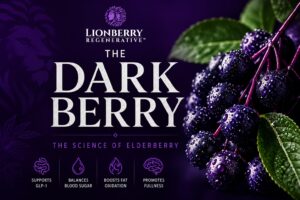
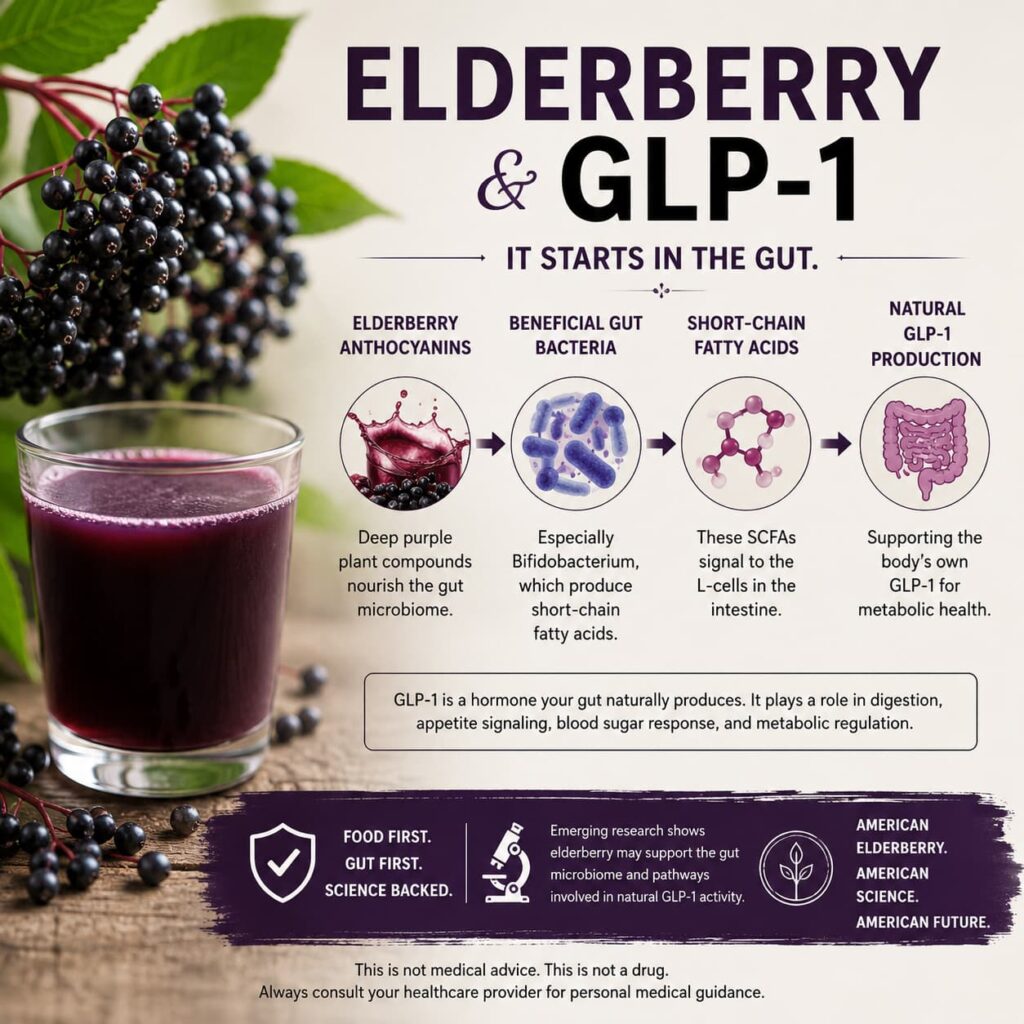
C3G is specifically a cyanidin molecule with a glucose molecule attached at the 3-position of its carbon ring. That structure matters for how it moves through your body and how it interacts with your gut. C3G is not a GLP-1 agonist. It does not bind to the GLP-1 receptor the way tirzepatide, Mounjaro, or Zepbound do. What it does is different and arguably more interesting… it stimulates your intestinal L cells to make more of your own GLP-1 from the inside [1]. The drug mimics the hormone from the outside. Elderberry… because it is food, because it is a berry, because it moves through your gut the way food does… triggers your body to produce the hormone itself. That is not a drug mechanism. That is food doing what food has always done. We just finally have the tools to watch it happen.
Research published in npj Science of Food confirmed that C3G treatment increased GLP-1 secretion in intestinal L cells via the PPARβ/δ… β-catenin… TCF-4 signaling pathway, which enhances the transcription of the proglucagon precursor that L cells use to synthesize GLP-1 [1]. C3G stimulates GLP-1 secretion from intestinal L cells via this pathway, thereby enhancing insulin secretion and improving glycemic control [1].
What the L Cell Is and What GLP-1 Does to Your Body
The L cell is a specialized enteroendocrine cell lining the wall of the intestine, concentrated in the ileum and colon. Its job is to sense what is coming through the gut… nutrients, fiber, certain plant compounds including C3G… and release hormonal signals in response [2]. GLP-1 is produced in intestinal L cells through posttranslational processing of the proglucagon gene and is released from the gut in response to nutrient ingestion [3].
Once C3G triggers the L cell and GLP-1 is secreted into circulation, it does multiple things simultaneously throughout the body that are directly relevant to blood sugar, metabolic health, and fat metabolism:
It tells the pancreas to release insulin in a glucose-dependent manner… meaning only when blood sugar is actually elevated, which is why it does not cause the hypoglycemic crashes that some diabetes medications do [3].
It blocks glucagon… the hormone that raises blood sugar… from being secreted by the pancreas, which further stabilizes blood glucose levels after meals [3].
It slows gastric emptying… food moves more slowly from the stomach into the small intestine… which flattens the blood sugar curve after eating, reduces postprandial glucose spikes, and extends the feeling of satiety [4].
It acts on GLP-1 receptors in the brainstem and hypothalamus to promote fullness and reduce appetite… GLP-1 has been shown to promote satiety and reduce both food and water intake [4].
It directly supports fat oxidation… the WSU clinical trial documented a 27% increase in fat oxidation at rest and during exercise in participants consuming elderberry juice for one week, consistent with the metabolic effects of increased endogenous GLP-1 activity [17].
The half-life of endogenous GLP-1 in circulation is approximately two minutes before it is degraded by the enzyme DPP-4 [4]. This is why pharmaceutical GLP-1 agonists are engineered to be DPP-4 resistant… they stay in the system far longer than your body’s own version. Elderberry does not extend the half-life. What it does is increase the rate of production… more signal from more L cells, more often, through food.
Is C3G Found More in American Elderberry
Both American elderberry (Sambucus canadensis) and European elderberry (Sambucus nigra) contain C3G. A USDA study comparing both species grown side by side found that both produce cyanidin-based anthocyanins as their dominant pigments, but with meaningfully different profiles [6]. In European elderberry, C3G makes up roughly 40 to 50% of total anthocyanins. In American elderberry, the dominant anthocyanins are acylated forms… meaning the cyanidin molecule has an additional organic acid group attached… making up approximately 65 to 70% of total anthocyanins, with C3G present but not dominant [15].
What matters for the L cell is not which species has the highest percentage of C3G on paper. What matters is how much active cyanidin-based compound arrives at the L cell intact after surviving processing, storage, and the journey through your gut. Acylated anthocyanins from American elderberry were more stable than cyanidin 3-sambubioside from European elderberry, with acylation improving both heat and light stability [6]. American elderberry’s acylated forms survive the journey better… and they break down in the gut into the same cyanidin-based compounds that stimulate L cell GLP-1 production [1].
Total anthocyanin content in American elderberry cultivars ranges from 85 to 385 mg per 100 grams depending on cultivar and growing conditions [7]. That nearly fourfold range is not a minor variation. It is the difference between a berry that moves the needle on L cell stimulation and one that does not. The Wyldewood and Bob Gordon cultivars are among the highest-anthocyanin American elderberry cultivars documented in the literature [16].
How C3G Gets to the L Cell
C3G faces a gauntlet between the berry and the L cell. Understanding that gauntlet explains why processing matters so much.
The stomach is actually C3G’s friend. The pH value of the stomach environment is generally 0.9 to 1.5. Anthocyanins are relatively stable at pH 2 or below and can be rapidly absorbed in the stomach, appearing in plasma within 30 minutes after ingestion. The acidity that protects the molecule in a well-processed elderberry product continues protecting it in the stomach. Some C3G absorbs directly through the stomach wall into circulation [9].
The challenge comes in the small intestine. Anthocyanins are destabilized by the neutral to slightly alkaline pH of the small intestine. As C3G moves from the acidic stomach into the small intestine the pH rises, the molecule becomes less stable, and some degrades. What survives is absorbed via the SGLT1 and GLUT2 glucose transporters in the intestinal wall [9]. Exposure to intestinal conditions leads to a decrease in C3G bioavailability by 40 to 50% overall [10].
What does not get absorbed intact continues to the colon where Bifidobacterium metabolizes it. Those metabolites stimulate L cells to produce more GLP-1 through the SCFA pathway… a second route to the same destination [11]. Two pathways. One berry. Both landing on the L cell.
How to Process Elderberry to Preserve C3G for the L Cell
This is where most of the commercial elderberry industry gets it wrong and most consumers have no way of knowing.
C3G is destroyed by heat, oxidation, light, and time. Heating elderberry at temperatures ranging from 212 to 302°F causes significant structural changes in anthocyanins, degrading both the bioactive compounds and their antioxidant activity [8]. Extended heat processing does not sterilize the medicine… it eliminates it.
Elderberry, with its softer peel structure, is more prone to anthocyanin degradation by heat than other berry fruits [8]. A blueberry or a grape can withstand certain processing conditions that will simply destroy elderberry anthocyanins.
What preserves C3G so it can actually reach the L cell:
- Fresh pressing or cold pressing to juice immediately after harvest
- Dropping the pH of the finished product acidifies the environment and stabilizes the C3G molecule structurally… the color shift from purple toward red confirms it is working [12]
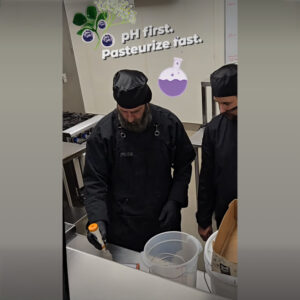
- Flash pasteurization at the lowest temperature and shortest time that achieves food safety requirements rather than extended boiling
- Cold storage to minimize oxidative degradation
- Processing as close to harvest as possible… anthocyanins degrade in the berry after picking even without heat
The color of the finished product tells you most of what you need to know. A deeply purple, almost black elderberry juice has retained its anthocyanins. A pale, brownish, or dull product has not. The color is not the brand. The color is the medicine. Trust the color.
METABOLIC RECOVERY
It starts with the dark berry.
Everything else follows from here.
Bevin Brooks
Business Secrets Weekly drops every Sunday at www.lionberry.us
References
[1] Xu, Y. et al. (2025). Cyanidin-3-O-glucoside enhances GLP-1 secretion via PPARβ/δ-β-catenin-TCF-4 pathway in type 2 diabetes mellitus. npj Science of Food, 9, 47. DOI: 10.1038/s41538-025-00445-4
[2] Habib, A.M. et al. (2021). What is an L-cell and how do we study the secretory mechanisms of the L-cell? Frontiers in Endocrinology, 12, 624009. DOI: 10.3389/fendo.2021.624009
[3] Drucker, D.J. (2002). The multiple actions of GLP-1 on the process of glucose-stimulated insulin secretion. Diabetes, 51(S3), S434–S442. DOI: 10.2337/diabetes.51.2007.S434
[4] Holst, J.J. (2007). The physiology of glucagon-like peptide 1. Physiological Reviews, 87(4), 1409–1439. DOI: 10.1152/physrev.00034.2006
[5] Drucker, D.J. (2006). The biology of incretin hormones. Cell Metabolism, 3(3), 153–165. DOI: 10.1016/j.cmet.2006.01.004
[6] Lee, J. & Finn, C.E. (2007). Anthocyanins and other polyphenolics in American elderberry (Sambucus canadensis) and European elderberry (Sambucus nigra) cultivars. Journal of the Science of Food and Agriculture, 87(14), 2665–2675. DOI: 10.1002/jsfa.3029
[7] Finn, C.E. et al. (2008). Fruit composition of elderberry (Sambucus spp.) genotypes grown in Oregon and Missouri, USA. HortScience, 43(5), 1501–1507. DOI: 10.21273/HORTSCI.43.5.1501
[8] Oancea, A.M. et al. (2018). The kinetics of thermal degradation of polyphenolic compounds from elderberry extract. Journal of Food Science and Technology, 55(2). DOI: 10.1177/1082013218756139
[9] Zou, T.B. et al. (2014). The role of sodium-dependent glucose transporter 1 and glucose transporter 2 in the absorption of cyanidin-3-O-β-glucoside. Nutrients, 6(10), 4165–4177. DOI: 10.3390/nu6104165
[10] Xu, Y. et al. (2023). Cyanidin-3-O-glucoside as a nutrigenomic factor in type 2 diabetes and its prominent impact on health. International Journal of Molecular Sciences, 24(10), 8875. DOI: 10.3390/ijms24108875
[11] Tolhurst, G. et al. (2012). Short-chain fatty acids stimulate glucagon-like peptide-1 secretion via the G-protein-coupled receptor FFAR2. Diabetes, 61(2), 364–371. DOI: 10.2337/db11-1019
[12] Khoo, H.E. et al. (2017). Anthocyanidins and anthocyanins: colored pigments as food, pharmaceutical ingredients, and the potential health benefits. Food & Nutrition Research, 61(1), 1361779. DOI: 10.1080/16546628.2017.1361779
[13] Chen, Z. et al. (2023). Preparation of an elderberry anthocyanin film and fresh-keeping effect of its application on fresh shrimps. PLOS ONE, 18(11), e0290650. DOI: 10.1371/journal.pone.0290650
[14] Liang, M. et al. (2023). Factors affecting the stability of anthocyanins and strategies for improving their stability. Food Chemistry: X, 20, 100867. DOI: 10.1016/j.fochx.2023.100867
[15] Kuhnau, J. (1976). The flavonoids: a class of semi-essential food components. World Review of Nutrition and Dietetics, 24, 117–191.
[16] Thomas, A.L. et al. (2015). Comparison of fruit characteristics among diverse elderberry genotypes grown in Missouri and Oregon. Journal of the American Pomological Society, 69(1), 2–14.
[17] Solverson, P. et al. (2024). A one-week elderberry juice intervention augments the fecal microbiota and suggests improvement in glucose tolerance and fat oxidation in a randomized controlled trial. Nutrients, 16(20), 3555. DOI: 10.3390/nu16203555