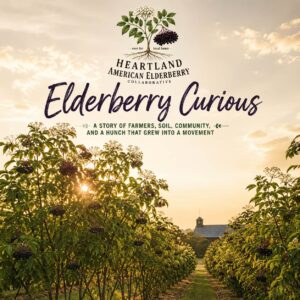
Elderberry Curious?

One elderberry plant. One hunch.

The hunch was that this plant… American elderberry (Sambucus canadensis, also classified by some authorities as Sambucus nigra subsp. canadensis)… was going to matter. Not just to my humble farm. Not just to my health. To my region. To the way we feed people. To the soil we leave behind.

I am a small elderberry grower in Spring Hill, Kansas. I am especially fascinated by the value-added side of agriculture and what happens when farmers can keep more of the value chain close to home.

For me, elderberry came in through the side door. I was using it on myself first.

I have brain tumors and something called mass effect. That is what happens when a tumor starts acting like a bully and pushing on nearby structures. In my case, it was creating inflammation around my hippocampus.

The elderberry helped. Not in a miraculous way. Not quickly. Over six or seven months I started noticing changes. I heard it before I understood it. My speech began clearing up. Words came easier. The fog seemed lighter.

Later, I had imaging through both KU and Mayo Clinic that showed a reduction in inflammation around my hippocampus.

Elderberry is rich in anthocyanins. One of the metabolites associated with those compounds is protocatechuic acid, which is capable of crossing the blood-brain barrier. A plant doing what plants have always done was my best explanation for what I was experiencing.

That changed what I was willing to do with my life.

That got my attention.

I wanted to know more. Not just how to grow it. How to grow it really well. How to process it without destroying what makes it worth growing. How to put it in front of more people without losing the thread that runs from soil to bottle to brain.

Ground to bottle to brain.

That became the question.

So I started driving. Not figuratively. Actually driving. Driving. Driving. Driving some more.

I started talking with Mickey Gallagher. Mickey is the Johnny Elderberry Seed of Kansas City. He has an ag degree, runs Farmyard KC, grows in high tunnels, and serves as caretaker of the American elderberry plantings at Casa Somerset for Michael Hursey. Mickey is that rare person who can pivot between irrigation, cultivars, grant paperwork, rocking his baby to sleep, and lunch plans all in the same conversation and never lose his place.

Lori Trojan was already there too. Wild Ivy Herb Farm. Master gardener. Master herbalist. Educator. Storyteller. And owner of one of the best laughs in the group. Lori learned this work the long way… through her mother, her grandmother, and the long quiet line of women who knew which plant did what before there was an internet to ask. The kind of knowledge you cannot get from Google because the people who held it never bothered to write it down.

And then there is Michael Hursey. Regional networker. Host. Champion of the small farmer. Michael has spent years pushing for vertical integration and finding ways for farmers to keep some of the value they create instead of handing it off three steps up the chain. Our earliest meetings happened at Casa Somerset.

That was the core.

Then I drove some more.

I took Michael Hursey to Elder Farms for a day of learning. I drove out to Lori’s farm, Wild Ivy Herb Farm, countless times. Lori and I visited Mark Allison and toured his elderberry winery. I toured wineries throughout Miami County and learned about agritourism through the network Mark helped build. I drove out to Cassandra at Wild Oaks in Missouri. I went down to Dave Buehler’s place in Mount Vernon as often as I could. I visited Jeremy Fyler at Fyler Farms in Missouri.

I go to as many conferences, seminars, farm groups, markets, workshops, and places where farmers can be found as I possibly can. I listen. I ask questions. I pay attention.

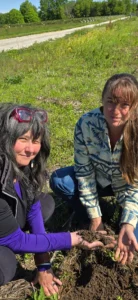
One of the things Mickey and I love most now is farm visits. That’s where we really get down in the dirt with people. With the farmers. With the growers. That’s where the real conversations happen.

At the same time, through my own elderberry business, I spend a lot of time in front of the public every week selling elderberry products, answering questions, and listening to what consumers actually care about.

I talked to farmers at farmers markets and dreamers at holiday boutiques and planners at home shows and people who had planted and people who wanted to plant and people who had never heard of elderberry and somehow ended up in a twenty-minute conversation with me anyway. Sorry to those people. Also you’re welcome.
Facebook
X
LinkedIn

When Words Lose Their Meaning

Lionberry 's Weekly Delusion and Re-illusion Update.

The phrase “food is medicine” has become the wellness world’s version of “thoughts and prayers.” Everyone says it. Everyone feels good saying it. And almost nobody means anything real when they do. That’s the danger—not the phrase itself, but what happens when language gets stretched so far it stops pointing to anything true.

The original use of the phrase belonged to grandmas, gardeners, and people who still know how to cook and where food comes from. In that world, “food is medicine” meant something simple and grounded. A piece of meat and some vegetables—and fruit when it was in season—was just a regular meal. And then there were the special things you made when someone didn’t feel well: mixtures built from botanicals, herbs, fruits, nuts, grasses, roots, seeds, and whatever the land offered that season. Things pulled straight from soil and pantry because they carried function, flavor, and a purpose. That usage was peaceful, instinctive, and honest.

Then came the influencers, using the same phrase while holding something powdered, flavored, and algorithm-optimized. “Food is medicine” became a caption under a neon shake that tastes like peach sorbet and contains a clinically irrelevant amount of plant dust. They didn’t inherit the meaning—they inherited the hashtag. And hashtags don’t carry wisdom; they carry trend cycles.

Then comes the USDA, NIH, and hospital systems, who use both phrases—but in different ways. “Food Is Medicine” is their broad, public-facing concept, the umbrella idea that nutrition is foundational for health. “Food As Medicine”—capital As—is the technical term for the clinical, billing-coded interventions:

produce prescriptions,

medically tailored meals,

medically tailored groceries.

This version has insurance pathways, reimbursement logic, metrics, screenings, and outcome evaluations. It isn’t a belief system. It’s a healthcare program.

So we end up with two phrases—Food Is Medicine and Food As Medicine—that sound almost identical but function in totally different worlds. And both of them, at their best, once pointed to something we still have right now: real plants growing from real soil, carrying real chemistry that does real things in the human body. Not ancient in the sense of “long ago,” but ancient in the sense of continuity—still alive, still growing, still here.

Once a phrase becomes universal, though, it becomes meaningless.

That’s what’s happening now.

A wellness word printed on plastic.

“Natural” stamped on a bag of potato chips.

“Immune-supporting” slapped on anything that wants to look virtuous.

Marketing fog replacing actual meaning.

It’s Peacekeepers in 1984.

It’s “community” in Big Tech.

And on the Idiocracy side, it’s the fictional Electrolyte Drink Brawndo—marketed so aggressively that the entire population believes “it’s got what plants crave.”

In the film, they irrigate crops with the Electrolyte Drink Brawndo instead of water because advertising has replaced knowledge. Marketing departments tell us what truth is. The soil dies. The crops fail. The land collapses into a dust bowl. That’s what linguistic drift does: it hollows meaning until the absurd becomes normal.

“Food is medicine” used to mean:

eat real plants,

respect soil,

trust the chemistry that grows in the field,

trust the phytonutrients that come from this earth,

food keeps you alive and makes you whole.

Now it means turmeric dust on junk food.

Or a wellness word added so a product can sell for $3 more.

This hollowed-out category is not a comfortable place for real food to sit.

The old category, where LionBerry sits—the one before wellness gloss, before powdered fantasy, before language drift washed the meaning out of the words—still exists. But sitting there is not accidental. People tell me all the time to cheapen it, powder it, plastic-bottle it, isolate it, dilute it, lab-flavor it, margin-boost it, and make it “scalable” by stripping out the thing that makes it real.

I don’t do it.

Not because it’s easy.

But because sometimes the right thing to do is always the hardest thing to do.

LionBerry sits in the old category because I fight for it to sit there.

Real plants.

Real chemistry.

Real soil.

Real function.

Zero powdered fantasy.

LionBerry is exactly what it says it is: a farm-crafted drink made out of actual food.

When I say “the phrase doesn’t need to be fixed,” I mean the phrase “food is medicine.”

We don’t need to invent a new set of buzzwords or rescue the old ones from misuse.

We don’t need to rebuild or replace the language itself.

What needs to change is this:

start making products that mean what the words used to mean.

Start making food products that are just food