Slaying the Cyclops

How the Twelve-Eyed Toad Sees What One Eye Cannot

A working treatise by Bevin Brooks

The Cyclops had one eye. One eye sees flat… no depth, no distance, no second opinion. And that’s every one of us if we’re honest. Every founder, every farmer alone with the thing they know, looking from the one spot they happen to stand on, falling in love with what they see and calling it truth. The oldest mistake isn’t being dumb. It’s being singular.

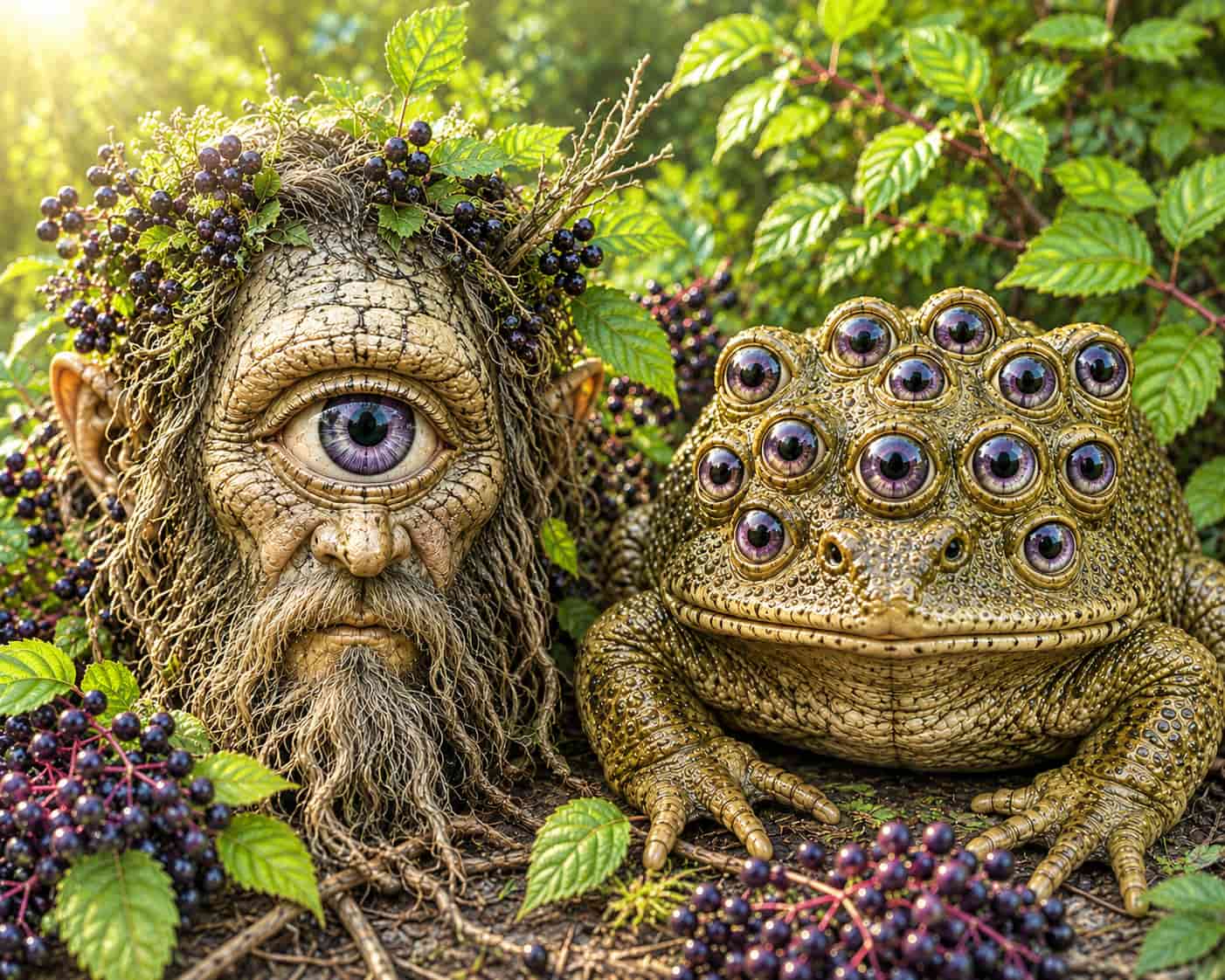
The fix isn’t getting smarter. A smarter Cyclops still has one eye. The fix is more eyes… set around the same thing, each catching what the others can’t. That’s the Twelve-Eyed Toad.

This is the oldest fight in philosophy, the One versus the Many. A hundred years ago William James planted his flag with the Many. He said the world isn’t a uni-verse, it’s a multi-verse… many real centers bumping into each other, the unity always partial, never sealed. He called the monist’s tidy world the block-universe. That’s the Cyclops exactly. One view, declared whole.

The Cyclops has a name out here in the dirt, and the name is consolidation. Big Ag is the one-eyed giant… one crop fence to fence, one buyer at the gate. Monoculture is just monism with a tractor on it. Take this price or take nothing. The farmer who grew the thing ends up the lowest-paid link in somebody else’s chain, picked off one at a time because every farmer’s standing there alone.

The answer isn’t one bigger farmer. A bigger Cyclops is still a Cyclops. The answer is a bunch of small farms that see together… growers and processors set around the same crop, each bringing the eye the others don’t have. That’s an AgriCluster. The Toad made out of real farms. It flips vertical integration on its head… integration by the farmers, not the giant. The money runs the other way. Down. Into the field, into the little town.

This is why the little emerging crops matter, and why the clock’s running. Elderberry, pawpaw, aronia, hazelnut… the ones the giant hasn’t flattened yet… still many growers, many ways, no single buyer owning the gate. The whole fight is to shape these crops on our terms before consolidation rolls in.

One thing keeps it honest. The Toad makes the questions… but reality casts the deciding vote. A bench of brilliant people can still be confidently wrong together. The eyes tell you what to go check. The numbers and the market tell you the answer.

So here’s the whole of it, and it’s a fight, not a meditation. Refuse the single view. Refuse the single buyer. Refuse the block-market. Build the bench. Build the cluster. Keep the crop plural, keep it farmer-held, keep the value down in the field that grew it.

The Cyclops is big. But it’s got one eye. We’ve got many. That’s how the small farm wins.
Facebook
X
LinkedIn

Fortifying the Heartland: My Christmas Wish for Hy-Vee.

Lionberry 's Weekly Delusion and Re-illusion Update.

This week’s delusion is pretending our grocery stores don’t have a weak point.

This week’s re-illusion is remembering that strength comes from building on what already works, not acting like we’re starting from scratch.

Hy-Vee does a really good job bringing in local barbecue sauces, jams, honey, and other value-added foods from the Heartland.

We’re not starting from zero.

But we are starting from small.

So I handed Santa a LionBerry and gave him my Christmas list:

A fortified Hy-Vee — one that expands the Heartland section that already exists into a full, accessible, stocked-every-day aisle for local foods.

Not to replace the global or national imports like Florida oranges, California almonds, Mexico avocados, pineapple juice from Thailand, or coastal produce —

but to stand beside them, so the region isn’t left vulnerable the next time anything shakes the system:

  • fuel shortages
  • war
  • trucking strikes
  • geopolitics
  • water shortages
  • drought or dust-bowl conditions
  • port disruptions
  • cyber hits
  • natural disasters

Any one of these can break a supply chain.

A fortified regional shelf — built from the farms around Kansas, Missouri, and Nebraska — keeps us fed.

The World Cup is coming to Kansas City.

Soccer tourists from Germany, Brazil, Japan, everywhere — living in Airbnbs for three to six weeks, shopping at Hy-Vee for everything from breakfast to body soap.

If we went to Germany, we’d want Wienerschnitzel.

If we went to Brazil, we’d want feijoada.

If we went to Japan, we’d want ramen or sushi that actually tastes like Japan.

So when they come to the Heartland, they don’t want a New York hot dog or a California cheeseburger.

They want us — the real Midwest.

What do we grow and make here?

  • local barbecue sauces
  • local fruit like blueberries
  • corn tortillas, tomato sauces, and beans
  • wheat pastas and breads
  • value-added soaps made from beef tallow
  • local meat, dairy, and eggs
  • elderberry drinks

And soccer tourists staying in AirBnB’s need actual essentials:

  • dish soap
  • cleaning agents
  • body soap and hygiene products
  • breakfast foods
  • snacks
  • drinks
  • basics
  • dinners

This is exactly why a stronger Heartland aisle matters — not just for crisis, but for culture, tourism, and everyday life.

This week’s delusion is pretending our grocery stores don’t have a weak point.
This week’s re-illusion is remembering that strength comes from building on what already works, not acting like we’re starting from scratch.

Hy-Vee does a really good job bringing in local barbecue sauces, jams, honey, and other value-added foods from the Heartland.
We’re not starting from zero.
But we are starting from small.

So I handed Santa a LionBerry and gave him my Christmas list:

A fortified Hy-Vee — one that expands the Heartland section that already exists into a full, accessible, stocked-every-day aisle for local foods.

Not to replace the global or national imports like Florida oranges, California almonds, Mexico avocados, pineapple juice from Thailand, or coastal produce —
but to stand beside them, so the region isn’t left vulnerable the next time anything shakes the system:

  • fuel shortages
  • war
  • trucking strikes
  • geopolitics
  • water shortages
  • drought or dust-bowl conditions
  • port disruptions
  • cyber hits
  • natural disasters

Any one of these can break a supply chain.
A fortified regional shelf — built from the farms around Kansas, Missouri, and Nebraska — keeps us fed.

The World Cup is coming to Kansas City.
Soccer tourists from Germany, Brazil, Japan, everywhere — living in Airbnbs for three to six weeks, shopping at Hy-Vee for everything from breakfast to body soap.

If we went to Germany, we’d want Wienerschnitzel.
If we went to Brazil, we’d want feijoada.
If we went to Japan, we’d want ramen or sushi that actually tastes like Japan.

So when they come to the Heartland, they don’t want a New York hot dog or a California cheeseburger.
They want us — the real Midwest.

What do we grow and make here?

  • local barbecue sauces
  • local fruit like blueberries
  • corn tortillas, tomato sauces, and beans
  • wheat pastas and breads
  • value-added soaps made from beef tallow
  • local meat, dairy, and eggs
  • elderberry drinks

And soccer tourists staying in Airbnbs need actual essentials:

  • dish soap
  • cleaning agents
  • body soap and hygiene products
  • breakfast foods
  • snacks
  • drinks
  • basics
  • dinners

This is exactly why a stronger Heartland aisle matters — not just for crisis, but for culture, tourism, and everyday life.

A shared warehouse, a shared distributor, and a unified block of local makers would let regional foods move with the same efficiency as national brands — while staying rooted right here.

Tourists will buy it.
Locals will keep it.
And if anything ever shakes the world, a fortified Hy-Vee keeps the Heartland standing.

That’s what I told Santa.
That’s my wish this year.
And that’s exactly what LionBerry is built to help do — bottle by bottle, aisle by aisle.